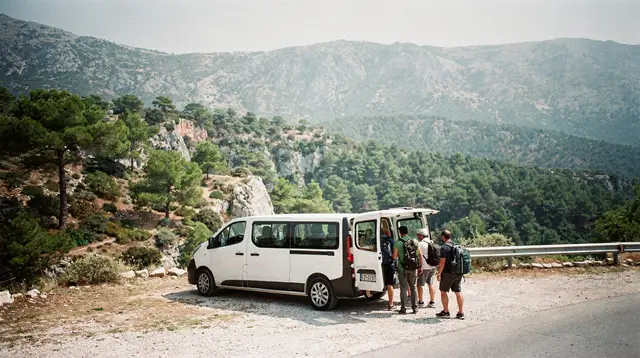
A harbour town outside the Antalya Riviera proper
Fethiye is a working port town on a wide bay in Turkey’s Muğla province, and it sits at the edge of what most people mean by “the Antalya Riviera” rather than inside it. The drive from Antalya covers roughly 200 km on winding coastal and mountain roads, which generally works out to around 3 to 3.5 hours — noticeably longer than the flat-road distance would suggest, since the route climbs and drops through forested hills for long stretches.
That single fact shapes almost everything about how to plan a visit: Fethiye is not a convenient Antalya day trip in the way Aspendos or Perge are. It’s a separate base, administratively and culturally tied more to Muğla — the same province as Bodrum and Marmaris — than to Antalya’s own resort belt.
The town itself centres on a modern marina lined with gulets and yachts, a lively fish market inside a covered bazaar hall where the catch of the day gets grilled to order at surrounding restaurants, and a waterfront promenade that fills with cruise passengers and long-stay visitors alike. Rock-cut Lycian tombs are carved directly into the cliff face overlooking the town, a visible reminder that Fethiye occupies the site of the ancient city of Telmessos. None of this reads like the purpose-built resort strips further east; Fethiye has an older, more lived-in feel, helped by a large expatriate community that has settled here over the past two decades.
Getting there and getting around
Most visitors arrive either by road from Antalya (via the D400 highway through Kaş, Kalkan and Kaputaş — itself a scenic coastal drive worth budgeting extra time for) or by flying into Dalaman Airport, which sits closer to Fethiye than Antalya’s own airport does. Once in town, Fethiye is walkable at its centre, but Ölüdeniz, Saklıkent and the surrounding beaches require a car, a dolmuş minibus, or an organised tour — public transport options thin out quickly once you leave the town centre.
| From Antalya | Distance | Typical drive time |
|---|---|---|
| Fethiye (via Kaş/Kalkan, D400) | ~200 km | ~3-3.5 hours |
| Ölüdeniz (from Fethiye centre) | ~15 km | ~25-30 minutes |
| Saklıkent Gorge (from Fethiye centre) | ~45 km | ~50-60 minutes |
Given those numbers, a day-trip tour from Antalya to Fethiye alone is uncommon; where Fethiye does appear on Antalya-based itineraries, it’s usually as one stop within a longer road trip that also takes in Kaş, Kalkan and Patara along the D400 corridor — a route covered by a guided drive along the D400 from Fethiye to Antalya through Kaş and Kaputaş.
Ölüdeniz: the lagoon and the paragliding view
Ölüdeniz is Fethiye’s best-known satellite and one of the most photographed spots on the Turkish coast: a shallow turquoise lagoon separated from the open sea by a long sandbar, backed by pine-covered hills. The lagoon itself sits inside a protected nature reserve with a small entry fee, while the adjoining Belcekız beach is free and lined with sunbeds and restaurants.
Ölüdeniz is also one of the world’s better-known paragliding launch points — tandem flights take off from Babadağ mountain above the town and land on the beach, giving a genuinely spectacular view of the lagoon from the air on a clear day. Wind conditions can ground flights on short notice, so it’s worth keeping plans flexible rather than scheduling a flight for a single fixed slot.
A broader loop tour covering Ölüdeniz alongside Kaş, Kalkan and Patara is available as a guided day tour taking in Ölüdeniz, Kaş, Kalkan and Patara beach, useful for visitors who want to see several of the Lycian coast’s best beaches without self-driving the whole route.
Saklıkent Gorge: cold water and a narrow canyon
Saklıkent is one of Turkey’s longest and deepest gorges, cut into the Akdağ mountains a short drive from Fethiye. A wooden walkway leads visitors over the roaring meltwater at the gorge mouth, and from there the route into the canyon itself involves wading through cold, fast-moving water — sturdy water shoes or sandals matter more here than they do at most sights on this coast, since the rock underfoot is slippery and the current has real force in places. The gorge can close after heavy rain because of flash-flood risk, so it’s worth checking conditions locally rather than assuming access on any given day. Trout restaurants built on wooden platforms over the river at the gorge entrance are a popular lunch stop before or after the walk.
A combined itinerary pairing Saklıkent with Kaputaş beach and the Kaş coastline runs as a day tour combining Kaş, Kaputaş beach and Saklıkent Canyon.
Sailing out of Fethiye
Fethiye’s marina is also a starting or finishing point for multi-day “Blue Cruise” gulet voyages along the Lycian coast, as well as shorter sunset cruises around the bay. A sunset boat tour around Fethiye Bay covers the shorter end of that spectrum, while longer routes connect Fethiye with Olympos and the Kemer coast over several days and nights aboard a traditional wooden gulet — a very different pace of travel from a single-day excursion, and one that needs its own dedicated trip planning rather than fitting inside an Antalya-based holiday.
Beaches and coves beyond Ölüdeniz
Ölüdeniz gets most of the attention, but the coastline between Fethiye and the Lycian towns further east holds several other beaches worth building into a longer stay. Kaputaş Beach is a narrow strip of sand at the foot of a steep staircase cut into the cliffs, reached from the D400 partway between Kalkan and Kaş — the kind of stop that works well as part of a coastal drive rather than a destination on its own, since parking is limited and the stairs mean it isn’t a beach for heavy loads of gear.
Further along, Patara offers something completely different: an 18-kilometre stretch of protected sand backed by dunes, with the ruins of the ancient Lycian city sitting just behind the beach itself.
Both sit well beyond a casual afternoon trip from Fethiye, which is why they tend to appear together with Saklıkent and Ölüdeniz on the same guided itineraries rather than as separate outings — a route covered by a Fethiye/Ölüdeniz, Kaş, Kaputaş and Saklıkent Canyon tour that strings several of these stops into one day, or the more beach-focused Kaş, Kaputaş Beach, Saklıkent Canyon and Patara coast discovery tour departing from Kaş.
Diving and water sports around Fethiye
The stretch of coast around Fethiye and Kaş is one of Turkey’s better-regarded diving areas, with clear water, rocky drop-offs, and a handful of wreck sites within reach of local dive boats. Kaş in particular has built up a reputation as a diving base over several decades, with operators running trips for both certified divers and first-timers trying an introductory dive.
Visitors staying in Fethiye who want to combine diving with the rest of the Lycian coast’s sights can look at a Fethiye tour combining Kaş scuba diving, Kaputaş Beach and Saklıkent Canyon, which pairs a dive session with two of the region’s best-known non-diving stops rather than dedicating an entire day to diving alone. Snorkelling is also possible directly off the sandbar at Ölüdeniz and around some of the bays reached by the sunset boat cruises out of Fethiye’s own marina.
Inland ruins: Xanthos and the Lycian interior
Away from the coast, the hills around Fethiye hold some of ancient Lycia’s most significant inland sites, including Xanthos, once the region’s political capital and home to distinctive pillar tombs and inscribed monuments that are unlike anything built elsewhere on this coast. These sites see far fewer visitors than Myra or Termessos closer to Antalya, partly because they sit slightly off the main coastal road and partly because they lack a single headline feature as dramatic as a rock-cut theatre or a mountaintop city.
A combined Xanthos, Saklıkent Canyon and Patara Beach tour is one practical way to see the ruins without dedicating a separate day to them, folding the detour into a route that already includes the gorge and the beach.
Where Fethiye fits against the rest of the coast
Compared with Kaş and Kalkan — smaller, quieter towns further along the same D400 road — Fethiye is larger, more built-up, and has considerably more infrastructure aimed at long-stay visitors and expatriates: supermarkets, private healthcare, real-estate agencies, and a bigger year-round population. It also sits closer to Dalaman Airport than to Antalya Airport, which is part of why many visitors book Fethiye as a standalone holiday rather than as an extension of an Antalya-based trip.
Travellers weighing the two commonly compare durations and pacing before committing — see the Antalya first-time planning guide and the best beaches on the Antalya coast for how Fethiye’s beaches stack up against Lara, Konyaaltı and the Kemer coves closer to Antalya itself.
For visitors determined to see Fethiye and Ölüdeniz within a broader Antalya-based trip, the practical options are: a long day tour along the D400 corridor (feasible but a full day on the road either way), an overnight or multi-night stopover partway through a longer road trip, or treating Fethiye as its own separate holiday reached via Dalaman rather than Antalya Airport. The ten-day Antalya, Lycian coast and Fethiye itinerary is built around exactly this pacing, spacing driving days so that Fethiye gets proper time rather than a rushed pass-through.
Practical notes for a Fethiye stay
Fethiye’s high season runs June through September, when the lagoon at Ölüdeniz and the gorge at Saklıkent both draw their biggest crowds; arriving early in the day noticeably improves both experiences. Spring (April-May) and early autumn (late September-October) bring milder temperatures better suited to the wading and walking involved at Saklıkent, along with thinner crowds at Ölüdeniz, though sea temperatures are cooler outside the core summer months.
As with the rest of the region, lira prices for tours, meals and paragliding flights move with Turkey’s ongoing inflation, so treat any specific figure — including the ranges above — as a dated snapshot rather than a fixed rate, and check a current exchange-rate source when budgeting. Tipping conventions match the rest of the Antalya region: roughly 5-10% in restaurants where service isn’t already included, and rounding up for taxis and informal services.
Getting around once you’re based in Fethiye
Renting a car is the most flexible way to cover Ölüdeniz, Saklıkent, Kaputaş and Patara from a Fethiye base, since several of these sights sit 30 minutes to an hour apart by road and dolmuş schedules thin out once the summer season ends. The general advice for renting and driving in the wider region — insurance, road conditions, fuel costs — applies equally here; see the renting a car in Antalya guide and the getting around the Antalya coast guide for the practicalities, even though both are framed around the Antalya side of the region.
Visitors without a car generally rely on a mix of dolmuş minibuses for short hops to Ölüdeniz, organised day tours for the longer routes toward Kaş, Kaputaş, Patara and Saklıkent, and taxis for anything time-sensitive, such as an early paragliding check-in or a dinner reservation across town.
Practical notes for a Fethiye stay
Fethiye’s high season runs June through September, when the lagoon at Ölüdeniz and the gorge at Saklıkent both draw their biggest crowds; arriving early in the day noticeably improves both experiences. Spring (April-May) and early autumn (late September-October) bring milder temperatures better suited to the wading and walking involved at Saklıkent, along with thinner crowds at Ölüdeniz, though sea temperatures are cooler outside the core summer months.
As with the rest of the region, lira prices for tours, meals and paragliding flights move with Turkey’s ongoing inflation, so treat any specific figure — including the ranges above — as a dated snapshot rather than a fixed rate, and check a current exchange-rate source when budgeting. Tipping conventions match the rest of the Antalya region: roughly 5-10% in restaurants where service isn’t already included, and rounding up for taxis and informal services.
Accommodation in Fethiye itself tends toward apartments and mid-range hotels aimed at longer stays, reflecting the town’s large expatriate and long-term-rental population, while Ölüdeniz concentrates more of the classic beach-resort hotel stock aimed at shorter holidays. Visitors who want beach access from their hotel door generally base themselves in or around Ölüdeniz or the nearby Hisarönü and Ovacık areas; those who want a livelier town centre with restaurants, the marina and the Tuesday market tend to stay in Fethiye proper and treat Ölüdeniz as a day visit rather than a base.
Fethiye travel FAQ
Is Fethiye part of the Antalya region?
Not administratively — Fethiye sits in Turkey’s Muğla province, the same province as Bodrum and Marmaris, rather than Antalya province. It’s included here as part of the wider Turquoise Coast because it connects naturally to the Lycian coast route through Kaş and Kalkan, but it’s best treated as its own destination rather than an extension of the Antalya Riviera.
Can I visit Fethiye as a day trip from Antalya?
It’s possible but demanding: the drive alone runs roughly 3 to 3.5 hours each way, so a day trip means around 6-7 hours of driving for a limited amount of time in Fethiye and Ölüdeniz. Most visitors who want to see Fethiye properly plan at least one overnight stay, or approach it as part of a longer Lycian coast road trip rather than a single-day return journey from Antalya.
How do I get from Fethiye to Ölüdeniz?
Ölüdeniz sits about 15 km from central Fethiye, roughly 25-30 minutes by road. Regular dolmuş minibuses run the route in season, and taxis are widely available; a rental car gives more flexibility if you’re also planning to reach Saklıkent or drive further along the coast toward Kaş.
Is Saklıkent Gorge suitable for children?
The walkway at the gorge entrance is manageable for most families, but the deeper canyon walk involves wading through cold, fast-moving water over slippery rock, which is more demanding and better suited to older children and confident walkers. Water shoes make a real difference, and it’s worth checking current conditions, since the gorge can close temporarily after heavy rain.
What’s the best way to see both Ölüdeniz and Saklıkent in one trip?
Guided day tours combining the two are common and remove the need to self-drive or coordinate dolmuş connections; a combined Kaş, Kaputaş and Saklıkent Canyon day tour covers Saklıkent alongside nearby beach stops, while Ölüdeniz is easily added as a half-day extension given how close it sits to central Fethiye.
Does Fethiye have its own airport?
Fethiye itself doesn’t have a commercial airport; most visitors fly into Dalaman Airport, which sits considerably closer to Fethiye than Antalya Airport does. This is part of why Fethiye tends to function as its own holiday base rather than a stop tacked onto an Antalya-airport-based trip.
When is the best time to visit Fethiye?
June through September is peak season for swimming at Ölüdeniz and flying paragliders off Babadağ, but also the busiest and hottest period. April, May, September and October offer a good balance — milder temperatures, thinner crowds, and more comfortable conditions for the wading and walking involved at Saklıkent Gorge.
Is Fethiye good for diving?
Yes — the coastline around Fethiye and nearby Kaş has clear water, rocky drop-offs and several wreck sites, and Kaş in particular has a long-established base of dive operators catering to both certified divers and first-time introductory divers. A combined tour pairing a dive session with Kaputaş Beach and Saklıkent Canyon is a practical way to fit diving into a broader day out rather than dedicating a full day to it alone.
What else is there to see near Fethiye besides Ölüdeniz and Saklıkent?
Beyond the two headline sights, the area holds Kaputaş Beach and the long protected beach at Patara further along the D400, the inland Lycian ruins at Xanthos, and Fethiye’s own rock-cut Lycian tombs overlooking the town centre. Multi-day Blue Cruise gulet voyages departing from Fethiye’s marina also reach Olympos and the Kemer coast for visitors with more time to spend on the water.