Two places, one bay
On a map, Olympos and Çıralı look like a single stretch of coastline, and in practice most visitors treat them that way — but they are two distinct places sharing one long pebble beach, and it helps to keep them separate before planning a visit. Olympos is the ancient Lycian city: a scatter of Roman and Byzantine ruins — a theatre, bath complex, sarcophagi, and a necropolis — spread through a river valley thick with fig trees, oleander and wild vegetation, opening directly onto the sea at its southern end. The nearby inland village, also called Olympos, is a strip of simple tree-house-style pansiyons (guesthouses) that has been a fixture on the backpacker trail through this coast for decades.
Çıralı sits at the northern end of the same bay, a short drive or a long beach walk away, and feels like a different kind of place altogether: a low-rise, low-key village of family-run pensions and small hotels set back from a long, flat, protected beach, with almost no ruins of its own and a much calmer, more residential atmosphere than either Olympos village or the resorts further along the coast in Kemer. Building height and beach development are both restricted here, which is precisely why it still looks the way it does.
For travellers coming from Antalya or staying in Kemer, the practical takeaway is this: decide whether you’re coming for ruins-and-beach (head for Olympos) or beach-and-quiet (head for Çıralı) — and if you have the time, do both, since they’re close enough to combine in a single day.
The ancient city of Olympos
The ruins at Olympos are unusual for this coast in how little they’ve been tidied up. Unlike the manicured, well-labelled sites at Perge or Aspendos, Olympos has been left largely as the forest found it: column drums half-swallowed by roots, a Roman-era bridge and bath house draped in vines, sarcophagi lids tipped at odd angles in the undergrowth. Walking the marked path along the valley floor and river takes most visitors somewhere between 45 minutes and two hours, depending on how much you stop to explore side paths and how far you wander among the fig trees.
The city was an important member of the Lycian League in antiquity and later passed through Roman and Byzantine hands, with a medieval castle (associated with Genoese and later pirate activity) still visible on the hillside above the harbour. There’s a paid entrance fee at the site gate near the beach car park; it’s a straightforward standalone ticket rather than something bundled automatically into a regional museum pass, so check current pricing at the gate. For background on other ancient sites in the wider region, see our overview of Antalya’s ancient sites.
The path through the ruins ends at Olympos Beach, a broad stretch of pebbles and coarse sand backed by pine-covered cliffs on both sides — a genuinely striking setting, if not the most comfortable underfoot without water shoes. Sunbeds and simple beach cafés operate seasonally near the entrance; further along, the shore is left undeveloped.
Çıralı beach and the turtles
Çıralı’s beach is the main draw for anyone based in the village: a long, gently curving stretch of protected coastline with far less commercial development than the beaches around Antalya city, such as Lara or Konyaaltı. It is a designated nesting site for loggerhead sea turtles (Caretta caretta), and during the nesting and hatching season — broadly May through October, with hatchlings typically emerging later in summer — sections of the beach are roped off and lit minimally after dark to protect nests. Sunbeds are limited by local regulation compared with more built-up resort beaches, part of why the setting has stayed as open and quiet as it has.
Çıralı village itself is small: a scatter of family-run guesthouses, a handful of restaurants serving simple grilled fish and Turkish home cooking, and very little in the way of nightlife or organised entertainment. It suits travellers looking to slow down for a day or two rather than pack in activities, though it also works well as a quiet overnight base before or after a more active day on the water or in the mountains — see our Kemer day trips guide for ideas that pair well with a Çıralı stay.
Getting there from Antalya and Kemer
Olympos and Çıralı sit roughly 80 km south of Antalya city and around 20-25 km south of central Kemer, reached via a turn-off from the coastal highway followed by a winding descent through pine forest — allow more time than the raw distance suggests, especially in summer traffic. From Antalya, figure on roughly 1 hour 15 minutes to 1 hour 30 minutes by car; from Kemer, closer to 30-40 minutes.
| From | Approx. distance | Approx. driving time |
|---|---|---|
| Antalya city | ~80 km | 1h15-1h30 |
| Kemer | ~20-25 km | 30-40 min |
| Tahtalı cable car base | ~15 km | 20-25 min |
Public dolmuş (minibus) services run between Antalya’s main bus terminal or Kemer and the Olympos turn-off on the highway, but the final stretch down to the beach and village is usually a separate, less frequent shuttle or a taxi — check current schedules locally rather than assuming a direct through-service.
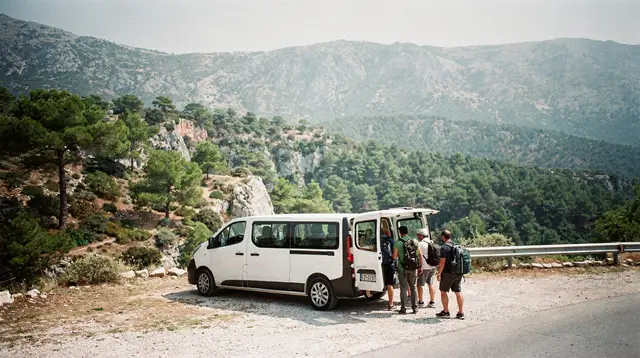
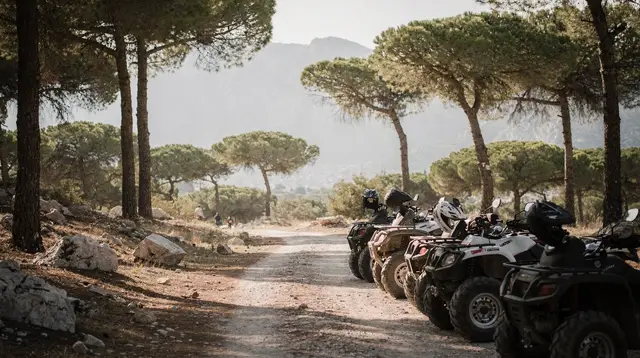
Many visitors instead book an organised day tour that handles transport door to door; a private tour combining Phaselis, Olympos and the Chimaera flames is a practical way to see all three in one day without arranging transfers yourself. For those based further along the coast, a jeep safari from Kemer to Olympos beach and the Chimaera flames covers similar ground with a more adventurous, off-road angle.
The Chimaera — a separate trip
The Chimaera (known locally as Yanartaş, “burning rock”) is one of the most-searched reasons people come to this stretch of coast, and it’s easy to assume it’s part of the Olympos ruins — it isn’t. The flames burn on a hillside a few kilometres from Olympos village, reached by a marked walking trail from its own car park, and they’re natural gas seeping continuously through cracks in the rock and igniting at the surface — not volcanic activity, and not connected underground to the ancient city. Because the flames are far more striking after dark, most visitors plan the walk for early evening. We cover the walk, timing and practicalities in a dedicated guide: Chimaera night hike.
Combining Olympos and Çıralı with the rest of the coast
Because Olympos sits roughly midway between Antalya and the Lycian coast towns further south, it fits naturally into a longer loop. The nearby harbour ruins of Phaselis and the mountain-top Tahtalı cable car are both short detours on the way down from Kemer, and the flame walk to the Chimaera adds well to an overnight stay. Further south, the beach village of Adrasan and boat trips out to the islet of Suluada make for a good add-on if you have an extra day, and the mountain village of Göynük offers a cooler, forested alternative if the coastal heat gets intense.
For a wider view of the water-based options in this stretch, a boat trip from Antalya or Kemer to Adrasan and Porto Genoese Bay with mud baths is a relaxed way to see the coastline from the water rather than the road. Longer-distance travellers sometimes use Olympos as a jumping-off point for a multi-day gulet cruise further along the coast — a Sail Turkey gulet cruise from Olympos to Fethiye covers this route over several days for those with more time to spare, taking in coves and bays that aren’t reachable by road at all.
Travellers planning a broader itinerary around this corner of the coast may also want to look at our three-day Kemer coast adventure itinerary, which sequences Olympos, Çıralı, Phaselis and the Chimaera into a workable few days without excessive backtracking.
Where to stay: village pansiyons or Çıralı pensions
Accommodation in Olympos village leans heavily toward the tree-house-style pansiyons that gave this stretch of coast its backpacker reputation: simple wooden cabins and bungalows, often with shared or basic en-suite bathrooms, usually including breakfast and dinner in the nightly rate since the village itself has few standalone restaurants. It’s a sociable, low-cost setup that suits travellers happy to trade polish for atmosphere — hammocks strung between trees, communal dinner tables, and a short walk down to the ruins and beach each morning.
Çıralı, by contrast, offers a quieter and generally more comfortable range of family-run pensions and small boutique hotels, most within walking distance of the beach and turtle-nesting shore. Rooms tend to be more private and better appointed than the Olympos tree-houses, though at a somewhat higher price, and the pace of the village matches: early nights, home-cooked breakfasts, and little in the way of organised evening entertainment. Neither village has large chain resorts — building restrictions have kept both places small — so travellers wanting pool bars, all-inclusive dining or nightlife are better served by Kemer itself or the coast around Antalya.
Either base works for a one-to-two-night stay built around the ruins, the beach and the Chimaera walk; the choice mostly comes down to whether you’d rather be a short stroll from the ancient city (Olympos village) or on the calmer, longer beach with the turtles (Çıralı).
Water activities beyond the beach
Swimming off Olympos and Çıralı beaches is free and unstructured, but the wider bay and coastline around this stretch also support a handful of boat-based day trips that pair naturally with a stay here.
South along the coast, the small islet of Suluada — sometimes marketed as Turkey’s answer to the Maldives for its shallow turquoise water — is reachable on organised boat tours that typically depart from Kemer; a Suluada boat tour with transfer from Antalya or Kemer covers the return trip and time on the water without needing your own transport to the harbour. Our Suluada boat trip guide has more detail on what these trips typically include.
Closer to hand, travellers who’d rather stay on the water than walk the ruins can combine Olympos with a relaxed coastal cruise; operators running trips along this part of the coast often stop at coves and swimming spots not reachable on foot, giving a different perspective on the same bay than the beach-level view from Olympos or Çıralı. For a broader look at boat-based options across the wider Kemer coast, see our Kemer boat trips guide.
Practical tips
- Footwear: Olympos Beach and the path through the ruins are pebbly and uneven in places; sturdy sandals or trainers make both far more comfortable than flip-flops.
- Bring cash: smaller pensions, beach cafés and the site ticket booth may not all take cards reliably — carry some Turkish lira in small denominations.
- Sun and shade: the ruins walk has patchy tree cover but the beach has very little shade near the entrance; a hat and sunscreen matter more here than at a developed resort beach with rented umbrellas.
- Turtle season etiquette: if visiting Çıralı between May and October, respect any roped-off nesting areas and avoid using bright lights on the beach after dark.
- Phone signal and amenities: both villages are deliberately low-key — don’t expect resort-level infrastructure, ATMs on every corner, or late-night options; it’s part of what keeps the area quiet.
- Combine, don’t rush: trying to fit Phaselis, Olympos, the Chimaera and Çıralı into a single half-day from Antalya is possible with an organised tour but tight if self-driving; an overnight stay lets you see the flames after dark without a late drive back.
Olympos and Çıralı: frequently asked questions
Is Olympos the same as Çıralı?
No. Olympos refers to the ancient Lycian ruins and the small inland village of guesthouses next to them, at the southern end of a shared bay. Çıralı is the separate, quieter beach village at the northern end of the same bay, known for its turtle-nesting shore rather than for ruins.
Do I need a ticket to visit the Olympos ruins?
Yes, there is a small paid entrance fee at the gate near the beach car park, separate from any regional museum pass — check current pricing locally, as it can change.
Is the Chimaera (Yanartaş) part of the Olympos ruins?
No. The Chimaera flames burn on a hillside a short walk from their own car park a few kilometres from Olympos village — it’s a separate visit, best done after dark, and is natural gas burning at the surface rather than volcanic activity.
Can I swim at both Olympos Beach and Çıralı Beach?
Yes, both are swimmable pebble-and-sand beaches on the same bay. Olympos Beach sits right at the mouth of the ancient city and has limited seasonal sunbeds near the entrance; Çıralı Beach is longer, quieter, and more residential, with sunbed numbers limited to help protect turtle nesting.
When do sea turtles nest at Çıralı?
Loggerhead turtles typically nest on Çıralı beach broadly between May and October, with hatchlings emerging later in the season. Sections of the beach may be roped off during this period — check locally for current restrictions before visiting.
How do I get from Antalya to Olympos without a rental car?
Dolmuş minibuses run from Antalya’s bus terminal toward the Olympos highway turn-off, with a further local transfer down to the beach and village; schedules can be infrequent, so many visitors instead book an organised day tour with door-to-door transport, or take a taxi for the final stretch.
Is Çıralı a good base for exploring the wider Kemer coast?
Yes, particularly for travellers who want a quiet overnight stay near Olympos, the Chimaera and Phaselis without being in a large resort town. It’s less convenient than Kemer itself for reaching Tahtalı or Antalya quickly, so it suits a slower one-to-two-night stop rather than a full base for day-tripping the whole region.
Are Olympos and Çıralı suitable for a day trip, or should I stay overnight?
Both work as a day trip from Antalya or Kemer, especially combined with Phaselis on an organised tour. Staying at least one night lets you see the Chimaera flames after dark without a late return drive, and gives more time to enjoy Çıralı’s beach at a relaxed pace.