Kaleiçi Old Town Guide: Antalya's Historic Centre on Foot
What is Kaleiçi and how much time do you need?
Kaleiçi is Antalya's old walled town — a compact grid of Ottoman-era lanes, the historic harbour, and Hadrian's Gate, best explored on foot. Two to three hours covers the highlights at a relaxed pace; a half day allows time for the harbour, the museum, and a tea break.
Kaleiçi is the reason Antalya has an old centre at all. Long before the city grew into the resort sprawl visible from a hotel balcony in Lara or Konyaaltı, this walled quarter above the harbour was Antalya — layered with Roman foundations, Byzantine and Seljuk fragments, and a dense weave of Ottoman-era houses that still define its lanes today. It sits apart from both beach districts, geographically and in character: no sand, no sunbeds, just stone, wood balconies, and a harbour that has sheltered boats for centuries.
This guide treats Kaleiçi as a walking destination rather than a checklist. It covers how the district is laid out, what you’ll actually see block by block, and — since this comes up constantly — whether to explore it on your own or book a guided walk.
Where Kaleiçi sits in Antalya
Kaleiçi is the old walled core of Antalya, tucked between the modern city centre and the Mediterranean cliffs above the harbour. It’s compact enough to cross on foot in under fifteen minutes end to end, though the appeal is in slowing down, not covering ground quickly.
The district connects easily to the rest of central Antalya. The AntRay tram and the scenic Nostalgic Tramway both run near its edges, and it’s an easy walk from the clifftop parks above the Lower Düden Falls viewpoint area. It is not, however, within walking distance of the city beaches — Konyaaltı is a short tram or taxi ride west, and Lara is considerably further east. Plan Kaleiçi and the beaches as separate outings rather than one long day covering both on foot.
Hadrian’s Gate: where most walks begin
The most recognisable single monument in Kaleiçi is Hadrian’s Gate, a triple-arched marble gateway built for a Roman emperor’s visit and still standing at what was once the edge of the ancient walled city. It marks a natural starting point for a walk, since it sits at the boundary between Kaleiçi’s old lanes and Antalya’s newer commercial streets.
The gate can be viewed and photographed from the street at no charge — it’s a freestanding monument, not an enclosed, ticketed site. From here, most walking routes head down into the old town’s grid, following the general slope toward the harbour.
The harbour and the clock tower
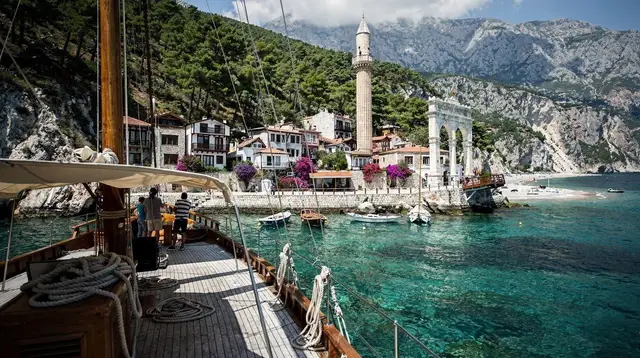
Antalya’s historic harbour is Kaleiçi’s other anchor point, sitting below the old walls at the base of the district. It’s a working small-boat harbour today, ringed by cafés, restaurants, and boat-trip operators offering short coastal cruises. Boat trips from here are a separate activity from the walking tour itself — worth considering if you have an extra hour and want a view of Kaleiçi’s cliffs from the water.
Above the harbour, the Saat Kulesi (Clock Tower) and the old city walls give a sense of how the fortified town once looked from the sea — a defensive line built to protect a harbour that was, for centuries, Antalya’s main connection to the wider Mediterranean.
Sitting at a harbourfront table for half an hour is, for many visitors, as much a part of Kaleiçi as any single monument. The cafés along the water face directly onto the boats, and the cliffs behind give the whole scene a backdrop that’s hard to photograph badly. If you’d rather see that same cliff line from the water instead of above it, a short cruise out of the harbour is the simplest way to do it — see the boat trips section further down for how that fits alongside the walking route.
Walking the lanes: what to expect
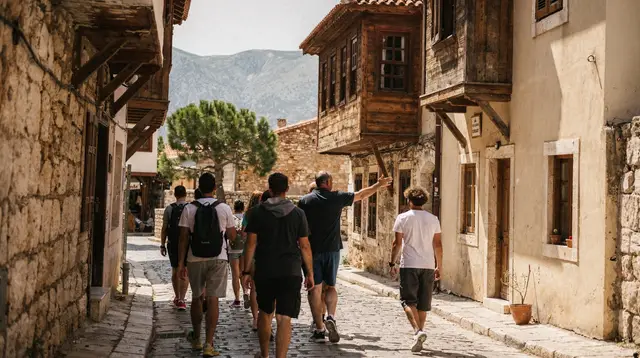
Kaleiçi’s interior is a dense, irregular grid of narrow lanes — not built for cars, and better explored without trying to force a route. Ottoman-era houses with overhanging wooden upper floors line many of the streets, a number of them converted into boutique hotels, guesthouses, and small restaurants, while others remain private homes. Look down as much as up: sections of Roman-era paving and column fragments surface unexpectedly between more recent buildings, a reminder that the district has been continuously inhabited and rebuilt for close to two thousand years.
A few features worth watching for as you walk:
- Yivli Minare (Fluted Minaret), a distinctive Seljuk-era landmark near Kaleiçi’s edge, visible from several angles as you move through the old town.
- Surviving stretches of the old city walls, particularly along the cliff line above the harbour.
- Small neighbourhood mosques tucked into residential lanes — dress modestly (shoulders and knees covered) if you step inside an active one.
- Antique shops, ceramics stalls, and carpet dealers concentrated on a handful of streets, where some gentle haggling is customary if you’re buying.
None of this requires a fixed route or a ticket. Kaleiçi rewards wandering, and getting mildly lost in the lanes is, for most visitors, part of the experience rather than a problem to solve.
Eating and drinking in Kaleiçi
Kaleiçi’s restaurant scene sits at two different speeds. The harbourfront and the streets closest to it are lined with restaurants aimed squarely at visitors — sea views, English menus, staff who’ll wave you in as you pass. Further back into the lanes, smaller places serving grilled meat, mezes, and traditional Turkish breakfast tend to draw more of a mixed crowd of residents and travellers, generally at gentler prices than the harbourfront tables. Neither approach is wrong; the harbour view has real value if that’s what you’re after, and the backstreet places reward a bit of wandering off the main routes described above.
If Turkish sweets interest you beyond just eating them, a kunefe cooking class with a local chef in the old town turns an hour of the visit into a hands-on activity rather than another sit-down meal — worth considering if you’re staying in Kaleiçi for more than a single afternoon. For a broader look at what to eat and where across the city, not just inside the old walls, see the Antalya food and markets guide and the Antalya local food guide.
Kaleiçi’s shopping streets — carpets, ceramics, leather, and antiques concentrated on a handful of lanes near the centre — work on a haggling culture that catches some first-time visitors off guard. Listed prices are usually a starting point rather than a fixed figure, particularly in the antique and carpet shops; the bazaars and haggling guide covers how that works in practice if you plan to buy anything more than a fridge magnet.
Kaleiçi in the evening
The character of Kaleiçi shifts noticeably after sunset. Daytime traffic through the lanes is mostly foot traffic headed somewhere specific — the harbour, a museum, a shop — while evenings bring a slower, more social pace: harbourfront restaurants fill their outdoor tables, lanterns and shopfront lighting pick out the wooden Ottoman façades that can look plain in flat midday sun, and the clock tower area draws a steady stream of after-dinner walkers. It’s a good time for photography if you don’t mind working with low light, and a noticeably cooler, more comfortable time to walk than the middle of a summer afternoon.
Free to walk, but not everything inside is free
It’s worth being precise here: walking Kaleiçi’s streets, harbour front, and city walls costs nothing. But the district isn’t a single free attraction — individual sites inside or near it, such as museums or specific ticketed monuments, charge their own entry fees, and those can change. Don’t assume blanket free access to everything inside the old walls; check current pricing for any specific site you plan to enter before you go.
Self-guided walk or a booked tour?
Both approaches work in Kaleiçi, and the right one depends on what you want out of the visit.
Walking on your own suits travellers who mainly want atmosphere — photographs of the wooden houses, a slow coffee near the harbour, browsing antique shops without a schedule. Kaleiçi is small and safe enough to navigate without guidance, and getting turned around in the lanes rarely costs more than a few extra minutes.
A guided walk adds the layer that’s easy to miss otherwise: which house dates from which century, what’s Roman versus Seljuk versus Ottoman under your feet, and the history behind Hadrian’s Gate and the harbour defences. If you’d rather understand what you’re looking at than just see it, a guide closes that gap in an hour or two that would otherwise take considerable independent research.
A structured option worth considering is an old town city tour that includes hotel transfer and lunch, which removes the logistics of getting to and from Kaleiçi entirely. For a walk focused specifically on the old city’s highlights, an old city walking tour covering Kaleiçi’s key sights is a more targeted option if you don’t need transfers included.
Several tours also pair Kaleiçi with other central Antalya sights in a single day. A city tour combining the old town with the Düden Waterfalls makes sense if you want to see the waterfalls without arranging separate transport, and a city tour combining the old town, an aquarium stop, and the waterfalls suits travellers with kids looking to combine a few different types of attractions into one organised day.
A simple two- to three-hour route
For travellers walking independently, this loop covers Kaleiçi’s core without doubling back excessively:
| Stop | What it offers | Approx. time |
|---|---|---|
| Hadrian’s Gate | Starting landmark, Roman triple-arched gateway | 10-15 min |
| Old town lanes (central grid) | Ottoman houses, shops, general wandering | 45-60 min |
| Yivli Minare area | Seljuk-era minaret, nearby streets | 15-20 min |
| City walls / clifftop stretch | Views over the harbour and coastline | 15-20 min |
| Harbour | Boats, cafés, optional short boat trip | 30-45 min+ |
This is a loose framework, not a fixed itinerary — Kaleiçi’s charm is in deviating from it.
Combining Kaleiçi with the rest of central Antalya
Because Kaleiçi sits centrally, it pairs naturally with other Antalya highlights on the same day. The Lower Düden Falls, where the river meets the sea, are a short trip from the old town and a common add-on for half-day tours. Travellers planning a longer stay often combine a Kaleiçi walk with a full day of Antalya’s city tours or fold it into a broader Antalya day trip itinerary that also reaches Perge or Termessos.
For a wider view of how Kaleiçi fits into a first Antalya visit, see the first-time planning guide, and for beach time afterward, compare Konyaaltı and Lara to decide which suits your base for the rest of the trip. If you’re also weighing a harbour boat trip from Kaleiçi against other coastal options, the Antalya boat trips guide lays out the choices, and travellers interested in the old town’s food scene specifically should see the Antalya food and markets guide.
For getting to and from Kaleiçi without a rental car, the getting around the Antalya coast guide covers the tram, taxis, and walking routes from nearby hotel areas, while the Antalya airport to hotel guide is the place to start if you’re arriving directly from AYT and want to fit Kaleiçi into your first day.
Combining Kaleiçi with a boat trip from the harbour and the Düden Waterfalls in one outing is a popular option for visitors who don’t want to arrange three separate days for three central Antalya sights. A Düden Waterfalls boat tour combined with a Kaleiçi tour or a Kaleiçi and Düden Waterfalls tour that includes lunch and a boat trip both fold the old town, the waterfalls, and a stretch of water together into a single organised day.
Travellers who’d rather skip the group format for something more private can look at a luxury old town tour that pairs Kaleiçi with a cable car and boat trip.
Practical tips for visiting Kaleiçi
Comfortable, closed shoes matter more here than almost anywhere else in central Antalya — the old town’s paving is a mix of cobblestone, worn stone, and the occasional uneven step, and it isn’t kind to sandals or heels over the course of a few hours. Carry cash in smaller denominations for shop purchases and any spontaneous café stop; not every small vendor in the lanes takes cards. The money in Antalya guide covers currency and tipping norms if you’re arriving without a feel for either.
Kaleiçi is one of the more relaxed parts of central Antalya after dark, but ordinary city-centre caution still applies — stick to lit, populated lanes late at night rather than cutting through empty side streets. See the Antalya safety guide for a fuller picture. If your walk takes you into any of the neighbourhood mosques mentioned above, the what to wear in Antalya mosques guide covers what’s expected in terms of dress and footwear before stepping inside.
Kaleiçi old town: frequently asked questions
Is Kaleiçi free to walk around?
Walking the streets, harbour front, and city walls of Kaleiçi costs nothing. Specific attractions inside or near the old town — such as museums or ticketed monuments — charge separate entry fees, so budget for those individually rather than assuming the whole district is free to visit.
How long does it take to see Kaleiçi?
A focused loop past Hadrian’s Gate, the harbour, and the main lanes takes roughly two hours. Add another hour or two for a museum stop, a coffee break, or simply getting pleasantly lost in the side streets, which is part of the appeal.
Can you drive into Kaleiçi?
Kaleiçi’s core is a pedestrian-oriented old town with narrow, often cobbled lanes unsuited to regular vehicle traffic. Most visitors park on the district’s edge or arrive by tram or on foot from central Antalya, then explore entirely on foot.
Is a guided tour worth it for Kaleiçi, or is it better to walk alone?
Walking alone works well if you just want atmosphere, photos, and a sense of the layout. A guided walk adds context on the Ottoman houses, the Roman and Byzantine layers under the streets, and Hadrian’s Gate’s history — worthwhile if you want the story behind what you’re seeing rather than just the view of it.
Where is Hadrian’s Gate and is it free?
Hadrian’s Gate stands at the southern edge of Kaleiçi, marking a historic entrance to the old town, and can be viewed and photographed from the street at no cost. It is a freestanding monument rather than a ticketed enclosure, though always check for any local access changes before visiting.
Is Kaleiçi close to Lara Beach or Konyaaltı Beach?
Kaleiçi sits in central Antalya, separate from both beach areas. Konyaaltı Beach is a short distance to the west, reachable by tram or taxi, while Lara Beach lies further east; neither beach is within walking distance of the old town, so plan them as separate outings.
What’s the best time of day to visit Kaleiçi?
Morning brings cooler temperatures and quieter lanes, good for photos and unhurried walking. Late afternoon into evening suits the harbour and waterfront restaurants, when the light softens and the area takes on a more relaxed, lived-in atmosphere.
Antalya City and Kaleiçi Tours
Verified deep-linked GetYourGuide tours. Book through these links and we earn a small commission at no cost to you.
GetYourGuide does not provide a product photo for this activity — the image shows the meeting point, photographed by us.