Belek Scuba Diving: Beginner Try-Dive or Certified Dive?
Can beginners go scuba diving in Belek without a certification?
Yes. Belek dive centres run supervised beginner try-dives (often called Discover Scuba or baptism dives) that need no prior certification, no swimming test beyond basic comfort in water, and no experience — a certified instructor stays with you throughout. Certified divers with a recognised card such as PADI Open Water can instead book fun dives to deeper reef and wreck-style sites along the coast.
Belek is best known for its golf courses and all-inclusive resort strip, but the same stretch of Mediterranean coastline that keeps its beaches calm also makes for reliable, easy-access diving. The question most first-time visitors face isn’t which dive site to pick — it’s whether they should book a beginner try-dive or a certified fun dive, and the two are different enough in requirements, depth, and experience that picking the wrong one can mean a wasted morning or a disappointing session.
Why Belek works for diving despite the golf-resort reputation
Belek sits on a relatively sheltered section of the Antalya coast, with sandy-bottomed bays and rocky outcrops close to shore. That combination of shallow, protected water near the beach and slightly deeper reef structure a short boat ride out is exactly what makes it workable for both ends of the diving spectrum: safe enough for a supervised first try, varied enough to hold the interest of someone who already dives elsewhere in the world.
Most operators running dives out of Belek also serve nearby Kemer, which has a longer-established diving scene and rockier, more dramatic underwater terrain. It’s common for a “Belek” dive booking to actually depart from or route through the Kemer coast, so don’t be surprised if your pickup or dive site sits outside Belek itself — check the tour description for the actual meeting point before you book.
Beginner try-dive: who it’s for and what actually happens
A beginner try-dive — often marketed as a “Discover Scuba” or “baptism” dive — is built for people who have never used scuba equipment before and have no certification. You don’t need diving experience, a swimming certificate, or any prior training. What you do need is basic water comfort: if you’re not able to relax and breathe normally with your face in the water, tell the instructor before the session so they can adjust.
The structure is deliberately simple. You’ll get a short briefing on land or on the boat covering hand signals, equalising your ears, and how to breathe through the regulator. Then an instructor takes you into the water — usually one-on-one or in a very small group — and stays in physical contact or close arm’s reach the entire time. There’s no independent swimming around; you’re guided, not left to navigate on your own.
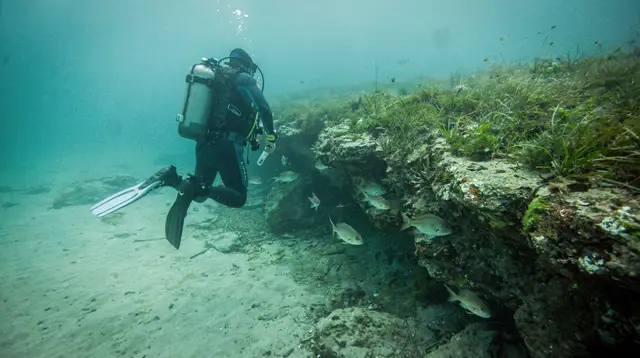
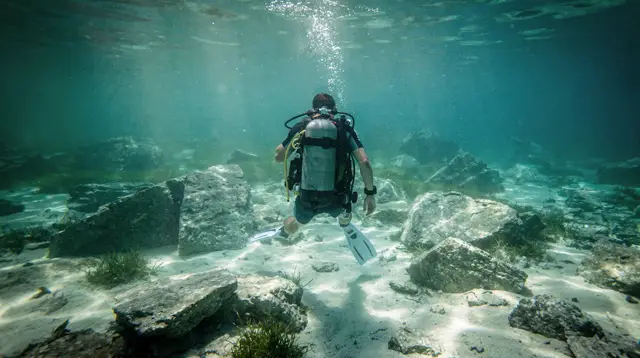
Depth on a try-dive is kept shallow, typically in the 5 to 12 metre range, in a bay with minimal current and decent visibility. That’s shallow enough to keep decompression risk essentially off the table for a single short dive and shallow enough that natural light still reaches the seabed, so you can actually see what you came to see — rocky reef, small fish, sponges, the occasional larger fish cruising past.
Total time in the water is usually brief, often 20 to 30 minutes of actual bottom time, bookended by a longer day that includes boat transport, briefing, and gearing up. If you’re booking specifically as a first-timer, the combined beginner and certified diving trip along the Belek and Kemer coast is built to handle exactly this level, with instructors used to first-time nerves.
Certified diving: what changes once you hold a card
If you already hold a recognised certification — PADI Open Water, SSI, CMAS or equivalent — the experience is a different category entirely. You’ll dive with a buddy or small group under the supervision of a divemaster or instructor, but without the constant physical guidance a try-dive requires. Expect a dive briefing covering the site, expected depth, entry and exit method, and any local hazards, then a dive planned around your certification level and logged dive experience.
Certified dives along the Belek-Kemer coast reach greater depths than try-dives, with sites offering more varied terrain — rocky walls, swim-throughs, occasional wreck-adjacent features depending on the operator and season. Bring your certification card (physical or digital) and photo ID; operators are required to verify this before letting you dive independently, and turning up without it can mean being bumped down to a supervised or refresher dive instead.
For a diver who wants two dives in a day, or wants to pair diving with other activity, the standalone scuba diving trip in the Mediterranean off Belek is aimed at this level, typically running as a boat-based two-tank outing. If you’d rather book a trip that explicitly covers both a two-dive certified outing and a pickup option from your hotel, the Kemer two-dive scuba diving tour with pickup option is built around exactly that structure, departing from the wider Antalya-Kemer coastline that most Belek operators also work from.
Water conditions and what you’ll actually see
Visibility along this stretch of coast is generally good outside of periods of heavy rain or strong wind-driven swell, when runoff and stirred sediment can reduce it noticeably for a day or two. Water temperature swings by season, warmest in the height of summer and noticeably cooler in spring and autumn, which is why most operators supply a wetsuit as standard rather than leaving it as an optional extra — worth confirming at booking if you run cold.
The seabed itself alternates between sandy patches, low rocky reef, and the occasional larger boulder formation, rather than the coral-reef scenery divers might expect from tropical destinations. That’s a fair trade for calm, current-free conditions that make it a forgiving place to learn: currents are typically mild in the sheltered bays used for try-dives, and the boat crew will choose a site to match conditions on the day rather than sticking rigidly to one location regardless of weather.
Beginner vs certified: a quick comparison
| Beginner try-dive | Certified fun dive | |
|---|---|---|
| Certification required | None | PADI/SSI/equivalent card |
| Supervision | Direct physical contact with instructor | Buddy/group with divemaster oversight |
| Typical depth | ~5-12m | Deeper, site- and level-dependent |
| Group size | Usually 1-on-1 or very small | Small buddy groups |
| Bottom time | ~20-30 minutes | Often two dives, longer per dive |
| Best for | First-timers, curious non-divers | Divers with a logged certification |
Choosing where to dive: Belek versus the wider coast
Belek’s own coastline is workable but modest compared to the more established diving hubs further along the Kemer coast around Phaselis and Olympos, where rockier terrain and deeper drop-offs give certified divers more to explore. If diving is the centrepiece of your trip rather than a one-off activity, it’s worth reading up on Kemer’s dedicated scuba diving guide or the broader Antalya scuba diving options before committing to a Belek-only operator.
That said, staying in Belek for the golf resorts, family-friendly beaches, and proximity to Land of Legends theme park while still fitting in a dive is entirely realistic — most dive operators pick up directly from Belek hotels, so you don’t lose a resort day to travel.
What a typical dive day looks like
Regardless of level, most Belek-area dive trips follow a similar shape:
- Hotel pickup, usually early-to-mid morning, covering Belek and often nearby Kemer or Antalya hotels.
- Briefing and gear fitting at the dive centre or on the boat — wetsuit, mask, fins, tank, regulator and buoyancy vest are typically included in the price.
- Boat transfer to the dive site, generally 15 to 40 minutes depending on conditions.
- The dive(s) — one supervised session for try-divers, one or two independent dives for certified divers.
- Surface interval and return, with snacks or water often provided between dives.
- Return transfer back to your hotel, usually early-to-mid afternoon.
Full days can run 4 to 6 hours door-to-door once transfers and surface intervals are factored in, so treat it as a half-day-plus commitment rather than a quick morning activity.
Practical preparation
Wear your swimsuit under your clothes to save time changing, and bring a towel, sunscreen, and water. Most operators supply all diving equipment, but it’s worth confirming this at booking rather than assuming — a small number charge extra for wetsuit rental or require you to bring your own mask. If you wear glasses or contact lenses, ask about prescription mask options in advance, since these aren’t always available on the day.
Seasickness is a genuine consideration on boat-based dives; if you’re prone to it, take precautions before boarding rather than after you start feeling unwell. And remember the post-dive flying guidance: wait at least 12 to 24 hours after diving before boarding a flight, longer after multiple dives, so schedule diving days away from your departure date.
Combining diving with other Belek activities
Because a dive day rarely fills an entire trip, many visitors pair it with land-based activity elsewhere on the itinerary. Options that run alongside diving trips from the same base include the ATV and zipline combination trip out of Side and Belek and the panoramic gyrocopter flight over the Belek coastline, which gives an aerial view of the same bays you’d otherwise only see from below the waterline.
For travellers weighing up a broader mix of Belek-area excursions before settling on diving specifically, the Belek category page for scuba diving and comparison guide to Side, Alanya and Kemer are useful starting points for working out where a given activity is actually based.
Diving elsewhere along the Turquoise Coast
Belek is a convenient base, but it’s one of several places along this coastline where diving is a realistic add-on to a beach holiday. Further west, Kaş has a longer-standing reputation among certified divers for clearer water and more varied terrain, and its own Kaş scuba diving guide covers what to expect there if your trip stretches that far along the coast. The Kaş scuba diving trip with beginner and expert options follows a similar beginner-versus-certified split to what you’ll find in Belek, just with a different stretch of seabed underneath.
Closer to Belek, Alanya in the other direction also runs a full beginner-to-certified diving scene, detailed in the Alanya scuba diving guide, and operators there such as the Alanya scuba diving trip for beginners and certified divers follow the same basic structure — a shallow supervised try-dive or a deeper certified outing, priced and timed similarly to what’s on offer out of Belek and Kemer.
If your itinerary keeps you closer to Antalya itself, the Antalya scuba diving guide rounds up options departing from the city rather than the resort belt, and the Antalya/Kemer scuba diving experience with a sunset option is worth a look if you’d rather dive later in the day than join an early-morning boat.
Booking tips
Confirm three things before paying for any dive trip in Belek: whether it’s a try-dive or requires certification, the actual departure/meeting point (Belek hotel pickup versus a Kemer marina), and what’s included in the price (equipment, transfers, photos). Certification checks happen at the dive centre, not at booking, so don’t assume an operator will catch a mismatch between your experience level and the trip type until you’re already there — read the listing carefully or ask directly if it’s unclear.
Frequently asked questions about diving in Belek
Do I need to know how to swim to try a beginner dive in Belek?
You should be reasonably comfortable in water, but centres do not usually require a formal swimming test for a shallow, instructor-led try-dive. If you are a weak or anxious swimmer, say so when booking so the instructor can adjust the plan or suggest a shorter, shallower session.
What is the difference between a try-dive and a certified dive in Belek?
A try-dive (sometimes called a baptism or Discover Scuba dive) is a short, shallow, one-on-one or small-group session for people with no certification, done entirely under an instructor’s direct control. A certified dive is for divers already holding a card such as PADI or SSI Open Water, diving in a buddy pair or group to greater depths and more varied sites, with the instructor or divemaster guiding rather than physically assisting.
How deep do beginner dives go in Belek?
Beginner try-dives are typically kept shallow, commonly in the region of 5 to 12 metres, in a sheltered bay area with good visibility and no current. Certified dives along this stretch of coast can go considerably deeper, depending on the diver’s certification level and the site.
Do I need my own scuba certification card for a fun dive?
Yes. Certified fun dives require proof of a recognised open-water certification (PADI, SSI or equivalent), usually your physical or digital certification card plus photo ID. Bring it with you or have a digital copy ready, since centres cannot verify certification on trust alone.
What should I bring on a scuba diving trip from Belek?
A swimsuit worn under your clothes, a towel, sunscreen (reef-safe if possible), water, and any personal medication. Most operators supply the wetsuit, mask, fins, tank, regulator and buoyancy vest as part of the price — check this when booking rather than assuming.
Is scuba diving in Belek suitable for children?
Many centres offer try-dives or supervised shallow-water introductions for children above a minimum age, often around 8 to 10, though rules vary by operator and equipment size. Confirm the minimum age and any parental presence requirements directly with the dive centre before booking a family session.
What marine life might I see diving off the Belek coast?
Expect rocky reef structures, sponges, small schooling fish, occasional groupers and wrasse, and sandy patches with rays or flatfish depending on the site and season. This coast is not known for dramatic megafauna, so treat any sighting of turtles or larger species as a bonus rather than a guarantee.
Can I fly the same day after a scuba dive in Belek?
No — standard diving guidance recommends waiting at least 12 to 24 hours after a dive before flying, to reduce decompression sickness risk, with longer intervals after multiple dives or deeper profiles. Plan your last dive well before your departure flight and ask your dive centre for their specific recommendation.
Scuba Diving and Snorkelling
Verified deep-linked GetYourGuide tours. Book through these links and we earn a small commission at no cost to you.
GetYourGuide does not provide a product photo for this activity — the image shows the meeting point, photographed by us.