Scuba Diving in Kemer: Discover Dive or Certified Dive?
What's the difference between a discover scuba dive and certified diving in Kemer?
A discover (or 'baptism') dive needs no certification or experience — a short briefing and a shallow dive with an instructor is enough. Certified diving requires a recognised card (PADI, SSI or similar) and opens up deeper, more varied sites along the Kemer coast, usually as two-dive trips.
Two very different dives under the same name
“Scuba diving in Kemer” covers two experiences that have almost nothing in common except the tank on your back. One is a short, closely supervised taste of breathing underwater for people who have never dived before. The other is a proper dive for certified divers, reaching sites and depths a first-timer never sees. Both are booked from the same stretch of coast around Kemer, often from the same dive centres, and the marketing rarely spells out which is which until you’re reading the fine print. This guide draws the line clearly, so you book the right one for where you actually are as a diver.
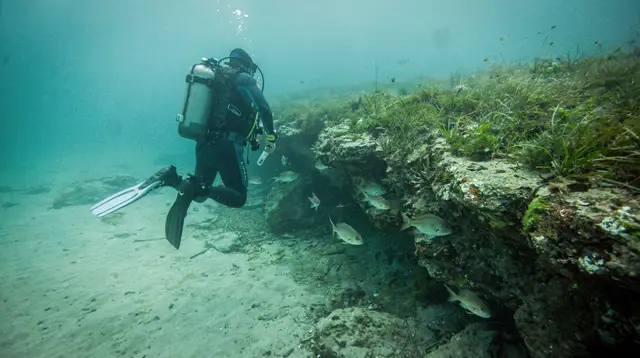
Kemer sits on a steep, pine-backed section of the Mediterranean, with the mountains dropping almost straight into clear water — a geography that happens to suit diving well. Visibility is generally good outside the busiest midsummer boat traffic, the water is warm from around May to October, and the coastline offers everything from shallow sandy bays to rockier drop-offs further along toward Phaselis and Olympos.
The discover dive: zero experience required
A discover (or “baptism”) dive is built for people who have never put on a tank before and aren’t sure whether diving is for them. There’s no certification course involved, no exam, and no prior dive log expected.
How it works. After hotel pickup, you’ll get a briefing on land covering hand signals, breathing through the regulator, and basic safety points — usually 20-30 minutes. An instructor then accompanies you into the water, often holding your arm or staying within touching distance for the entire dive. You’re never navigating, checking gauges, or making decisions alone; the instructor manages depth, timing and your air supply awareness throughout.
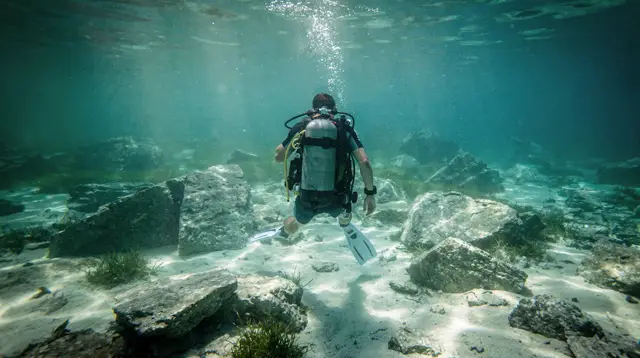
Depth and duration. Discover dives stay shallow, typically in the 5-12m range, over a sandy or gently sloping seabed rather than a dramatic wall or wreck. The dive itself usually lasts 20-40 minutes, short enough to keep it manageable for someone breathing compressed air for the first time.
Who it suits. Curious travellers on a beach holiday, families with older kids or teens, and anyone who wants to know what diving feels like before committing to a multi-day certification course. It’s a taste, not a qualification — you won’t be able to dive unsupervised afterwards, and it doesn’t count toward any certification level.
What’s provided. All equipment (wetsuit, tank, BCD, mask, fins, regulator) is included, along with the instructor’s time and usually transfer and lunch. You show up in swimwear and a towel.
For a straightforward first taste, a discover scuba diving experience in Kemer is built exactly for this — no certification, no prior experience, just a guided introduction to breathing underwater.
Certified diving: bring your card, go deeper
If you already hold a recognised certification — PADI Open Water, SSI, CMAS or an equivalent — the Kemer coast opens up considerably. Certified dives are typically sold as two-dive trips, letting you visit two different sites in a day rather than one shallow introduction.
What you need. A physical or digital certification card is the standard requirement; some operators also ask how recently you last dived, and may suggest an easier first site if it’s been over a year. Bring your own certification proof — operators generally can’t verify it any other way on the day.
Depth and sites. Certified divers can reach 18-30m depending on the site and their certification level (Open Water divers are typically capped around 18m, Advanced Open Water around 30m). This depth range reaches rockier terrain, small wrecks in places, and reef structures that discover dives never get close to, along the coast toward Phaselis and beyond.
Equipment. Full gear is generally included in package trips (tank, weights, BCD, regulator, wetsuit), though some divers bring their own mask, fins or dive computer for comfort and familiarity. It’s worth checking what’s included versus rentable when booking, since gear lists vary by operator.
Pacing. Unlike a discover dive, certified diving assumes you can manage your own buoyancy, monitor your air supply, and follow dive signals independently, with a guide leading the group rather than physically assisting each diver. It’s a genuine dive, not a supervised sample.
For divers with a card in hand, a two-dive scuba experience with lunch covers a fuller day on the water, while a full-day scuba diving adventure from Antalya/Kemer extends the range further for those wanting more time and more sites in one outing.
What the underwater terrain looks like
The Kemer coastline is defined by mountains that drop almost straight into the sea, and that geology carries underwater too. Rather than one long featureless sandbank, the seabed shifts between sheltered sandy bays close to shore — where discover dives are usually run, for calmer conditions and easier buoyancy control — and rockier, more broken terrain further out and further along the coast toward Phaselis and Olympos, where certified two-dive trips tend to head.
Visibility on the Kemer coast is generally good for Mediterranean diving, though like anywhere it varies with recent weather, boat traffic and the time of year — early and late season (May, June, September, October) often brings calmer water and fewer boats than the peak of midsummer. Water temperature follows the same curve: cooler and requiring a fuller wetsuit at the shoulders of the season, warmer and more forgiving at the height of summer.
Marine life around these sites is typical of the eastern Mediterranean — expect small reef fish, occasional larger schools, and rocky outcrops with the kind of texture that makes for interesting swim-throughs on the deeper certified sites, rather than the dramatic coral-reef colour of tropical diving further afield. It’s a different style of diving to somewhere like the Red Sea, closer in character and marine biodiversity to Aegean or wider Mediterranean sites, which is worth knowing if you’ve dived in warmer, more colourful waters before and want to calibrate expectations.
Certification courses vs one-off dives
Everything above covers single-session diving — a discover dive as a one-time taste, or certified diving as a day trip for those who already hold a card. If you’re interested in leaving Kemer with an actual certification rather than just a logged dive or two, that’s a separate, multi-day product: a PADI Open Water course (or equivalent) typically runs over several days, combining classroom or e-learning theory, confined-water skills practice, and a set number of open-water dives to complete the qualification.
That kind of multi-day course sits outside the scope of the single-day trips covered here, and isn’t something to book on a whim if your holiday schedule is tight — factor in enough consecutive days, since courses can’t usually be compressed without cutting corners on skills practice. If a full certification is what you’re after, ask a Kemer dive centre directly about current course structure and duration rather than assuming it matches a single discover dive booking.
How Kemer compares with diving elsewhere on the coast
Kemer isn’t the only diving base on this stretch of Turkey’s Mediterranean coast. Further east, scuba diving out of Kaş is known among divers for clearer water and more dramatic underwater terrain, including some well-known technical sites, while closer to Antalya city, scuba diving in Antalya covers the same discover-versus-certified split from a different departure point.
Further along toward Alanya, Alanya’s beginner and certified diving options follow a broadly similar structure again, so the choice between bases often comes down to where you’re actually staying rather than a major difference in what’s on offer.
For most Kemer-based travellers, the practical answer is simple: dive from wherever you’re staying unless you have a specific reason — a particular wreck, a known dive site, or a day trip already planned — to travel further along the coast. The added transfer time to reach Kaş or Alanya rarely pays off for a single discover or two-dive outing when broadly comparable diving exists right off the Kemer coast.
Booking considerations before you commit
Group size. Discover dives are sometimes run with several first-timers per instructor, which affects how much individual attention you get; if that matters to you, ask about the instructor-to-diver ratio when booking rather than assuming a 1-to-1 setup.
Medical conditions. Certain health conditions — including some heart and respiratory issues, recent surgery, or pregnancy — are standard contraindications for diving anywhere, not just Kemer. If you have any relevant condition, check with a doctor before booking rather than disclosing it for the first time at the dive centre on the day.
Seasickness. Boat-based dive trips involve time on the water beyond the dive itself, including the transit out to the site; if you’re prone to seasickness, consider it before committing to a longer two-dive boat trip versus a shorter shore-based discover session.
Flying after diving. A standard rule across the diving industry is to leave a gap of at least several hours — commonly a day for multiple dives — between your last dive and a flight home, to avoid decompression sickness risk from cabin pressure changes. If diving is planned near the end of your trip, check this against your flight time and build in a buffer rather than diving the morning of a departure.
Side-by-side comparison
| Discover dive | Certified diving | |
|---|---|---|
| Certification needed | None | PADI/SSI/CMAS or equivalent |
| Prior experience | None required | Some diving history helpful |
| Typical depth | 5-12m | 18-30m |
| Supervision | Instructor holds/guides throughout | Guide leads group, divers self-manage |
| Number of dives | Usually 1 | Usually 2 |
| Duration underwater | 20-40 minutes | Two dives, ~30-45 min each |
| Sites reached | Shallow sandy bays | Reefs, rockier terrain, some wreck sites |
| Best for | First-timers, curious travellers | Divers wanting to log real dive time |
Choosing the right trip for your level
If you’ve never dived and just want to see what it’s like, a discover dive is the honest starting point — no pressure to perform, an instructor within arm’s reach, and a shallow, forgiving setting. It won’t feel like “real” diving to someone already certified, but that’s not the point; it’s designed to be approachable.
If you’re certified and haven’t dived in a while, or you’re diving somewhere new for the first time, mention that when booking. Most centres will ease you in with an easier first site before moving to anything more demanding on the second dive of the day.
Travellers who are unsure whether they’ll like diving but are drawn to the idea of open water more broadly sometimes do better starting with a boat trip that includes swimming stops rather than committing to tanks and a briefing — a boat trip to Suluada with lunch is a lower-commitment way to spend a day on the water around the same coastline, with clear swimming spots along the way.
Practical planning notes
Season. Diving around Kemer runs roughly from April/May to October, tracking the Mediterranean swimming season. Outside these months, water temperatures drop and most dive centres reduce or pause operations — check current-year dates before planning a trip near either edge of the season.
What to bring. Swimwear, a towel, sunscreen (reef-safe where possible), and a change of clothes. Underwater cameras or GoPros are sometimes rentable, and some operators offer a photo/video package covering your dive — worth asking about in advance if you want photos without carrying your own gear.
Health and comfort. Basic swimming ability and general fitness are expected for either option. Ear clearing during descent is the main technique taught in the discover-dive briefing; if you’ve had trouble with ear pressure on flights before, mention it to the instructor.
Transfers. Most trips include hotel pickup and drop-off from Kemer-area accommodation; confirm your pickup point covers your specific hotel when booking, particularly if you’re staying slightly outside central Kemer.
Timing your trip. A sunset variant exists for those wanting a different atmosphere on the water — a sunset scuba diving adventure with hotel pickup combines the diving experience with evening light, generally aimed at those with some comfort in the water already given the later, cooler conditions.
Where this fits into a Kemer trip
Diving is one activity among several on the Kemer coast, which also covers the Tahtalı cable car, the ruined harbour city of Phaselis, and boat trips to Suluada and Adrasan. If diving is the centrepiece of your day, pair it with a relaxed evening in Kemer rather than stacking another excursion on top — dive days involve early starts and can be more tiring than they look, especially for first-timers adjusting to breathing underwater.
For travellers weighing options across the wider region, see how scuba diving in Antalya compares, or browse things to do in Kemer for the full range of boat trips, cable cars and day trips based here. Those building a longer itinerary might also look at Kemer day trips or the broader three-day Kemer coast adventure itinerary for how diving fits alongside the area’s other highlights.
Frequently asked questions about scuba diving in Kemer
Do I need to know how to swim to try scuba diving in Kemer?
Most operators ask for basic swimming ability and general comfort in the water, though you don’t need to be a strong swimmer. Discover dives are conducted with an instructor holding or guiding you throughout, so confidence in water matters more than technique.
What is the minimum age for a discover scuba dive in Kemer?
Many operators accept children from around 8-10 years old for shallow discover dives, though minimum ages vary by company and are sometimes tied to a swimming test. Always check the specific age policy when booking rather than assuming a standard applies.
How deep do you go on a beginner dive versus a certified dive near Kemer?
A discover dive typically stays in the 5-12m range, close to a sandy or gently sloping seabed. Certified divers can go deeper, often 18-30m depending on the site and certification level, opening up wrecks, reefs and rock formations not reached on introductory dives.
Can I go scuba diving in Kemer if I’m already certified elsewhere?
Yes. Bringing a PADI, SSI, CMAS or equivalent certification card lets you book directly onto certified dive trips without repeating a discover session, though some operators still ask for a short check dive if it’s been a long time since your last dive.
Is scuba diving in Kemer available year-round?
Diving generally runs from around April/May through October, in line with the Mediterranean swimming season, when the sea is warm enough for comfortable diving without a thick wetsuit. Outside these months, most dive centres scale back or pause operations.
What’s included in a typical Kemer scuba diving trip?
Most packages include hotel pickup and drop-off, all diving equipment, a briefing, the dive(s) themselves with an instructor or guide, and often lunch. Certification cards, dive computers for personal use, or underwater photo packages are sometimes extra.
Scuba Diving and Snorkelling
Verified deep-linked GetYourGuide tours. Book through these links and we earn a small commission at no cost to you.
GetYourGuide does not provide a product photo for this activity — the image shows the meeting point, photographed by us.