Antalya Accessibility Guide: What's Easy and What's Hard to Reach
Is Antalya accessible for visitors with limited mobility?
Parts of it are: Lara Beach, Konyaaltı Beach and Belek's resort strip have paved promenades, ramps and beach-access matting. Kaleiçi's old town, Kaputaş Beach's cliff staircase, and inland sites like Termessos and Saklıkent involve cobbles, steps or uneven ground that are genuinely difficult for wheelchair users or anyone unsteady on their feet.
Reading this coast for accessibility, not just scenery
Antalya’s tourism marketing shows every beach, ruin and canyon as equally reachable, and that simply isn’t true on the ground. Some of the region’s biggest draws sit behind long staircases, uneven stone paths or cobbled lanes that were never built with ramps, wheelchairs or unsteady footing in mind. Others — a handful of city beaches, a few resort strips, most boat trips — are genuinely easy. This guide sorts the region’s best-known sites into those two groups, so a visitor with limited mobility, a wheelchair user, someone recovering from an injury, or a parent pushing a stroller over long distances can plan around what actually works rather than discovering the gap at the foot of a staircase.
None of this is an official accessibility audit — conditions change, ramps get added or worn down, and “accessible” can mean different things depending on the type and degree of mobility limitation involved. Treat the guidance below as a starting point for questions to ask a tour operator or hotel directly, not a guarantee.
The easy end: beaches and resort areas
The most straightforwardly accessible stretches of coast are the ones built for mass tourism rather than historic character.
Lara Beach and Konyaaltı Beach, both a short distance from Antalya city, have paved seafront promenades running their length, with parking, cafés and facilities close to the sand. Sections of both have beach-access matting laid toward the waterline in season, which makes a real difference for wheelchairs and even for anyone who finds loose pebbles or shifting sand difficult underfoot. Neither is flawless — matting doesn’t always reach all the way to the water, and gaps appear off-season — but they are the two most dependable city beaches for limited mobility. For a direct comparison of the two, see our Konyaaltı vs Lara Beach guide.
Belek, the region’s golf-resort area, tends to be the easiest coastal base overall. Its large all-inclusive hotels routinely build their own ramps, boardwalks and lift access to the beach, since a meaningful share of their guests are older travellers or families who value flat, direct routes. If step-free access matters more than atmosphere, a Belek resort beach is usually a safer bet than a public stretch elsewhere on the coast.
By contrast, smaller cove beaches favoured for their views — Kaputaş Beach chief among them — trade accessibility for scenery. Kaputaş sits at the bottom of a steep cliff, reached only by a long flight of concrete stairs with no ramp, lift or alternative route. It’s a striking turquoise cove and a reasonable stop for anyone who can manage stairs, but for a wheelchair user or anyone who can’t do sustained steps, it functions as a roadside viewpoint rather than a place to swim. For a broader overview of which coves and beaches suit which visitor, our best beaches on the Antalya coast guide flags terrain alongside sand quality.
Further along the coast, Cleopatra Beach in Alanya sits below the town’s hilltop castle and is one of the wider, sandier stretches on this part of the coast, with a promenade running behind it and beachfront cafés close to the sand — generally easier going than a rocky cove, though as with any beach it’s worth checking current matting and access-point conditions in season rather than assuming they’re in place year-round.
Antalya’s old town: doable, but slow
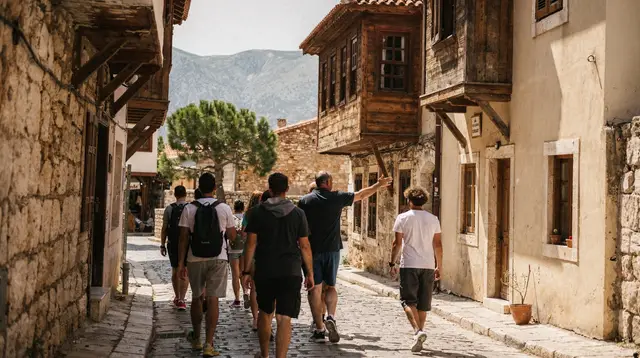
Kaleiçi, Antalya’s historic old town around the harbour, is one of the region’s most-visited sights and also one of its least step-free. The lanes are narrow, often sloped, and paved in old cobblestone that has been smoothed by centuries of foot traffic rather than resurfaced for wheeled access. Around the harbour itself there are steps down to the marina level in several spots, and pavement quality varies block to block — some stretches are relatively even, others distinctly rough.
That doesn’t rule Kaleiçi out. A wheelchair user or a visitor using a cane can still see the clock tower, the main pedestrian lanes near Hadrian’s Gate, and much of the harbourfront by choosing routes carefully and expecting a slower pace than on flat ground. It’s worth treating a Kaleiçi visit as a partial exploration rather than a full loop, and pairing it with a guided option that already knows which lanes to avoid — our Kaleiçi old town guide breaks down the district by area, which helps with planning a shorter, flatter route in advance.
A guided city tour such as a guided Antalya old city tour can also help by setting a manageable pace and pointing out the more level stretches rather than improvising on the day.
Ruins and ancient sites: a wide range
Antalya’s Roman and Lycian ruins vary enormously in how walkable they are, and this is where assuming “ancient site” means “similar terrain” causes the most frustration.
Perge and Aspendos are both relatively approachable: much of Perge’s site is on level or gently sloped ground once past the entrance, and Aspendos’s Roman theatre, while it does involve tiered stone seating typical of ancient theatres, has a flatter approach and lower section that many visitors with moderate mobility manage without difficulty. Neither is fully step-free, but both are markedly easier than the mountain sites further inland.
Termessos, by contrast, is one of the region’s most physically demanding sites. It sits inside a forested national park on a mountainside, reached by a walk and climb over uneven, sometimes steep stone paths with no paved or graded route. There is no practical way to see most of Termessos without sustained, uneven walking, so it’s realistically not a fit for wheelchair users or anyone with significant mobility limitations — the dramatic mountaintop setting that makes it worthwhile is also what makes it hard to reach.
Side’s old town sits in an unusual middle ground: its ruins are woven directly into the modern town on a flat coastal peninsula, so a fair amount can be seen on level paved streets without a formal ticketed climb, which makes it noticeably easier going than Termessos despite also being an ancient site. A guided option that includes transfers, such as a guided Side and Antalya city tour with waterfall stop, removes some of the walking burden by handling transport between points rather than requiring a long approach on foot.
Myra, near Demre, involves paved paths near the rock-cut tombs and theatre with some uneven ground and steps closer to the tomb façades — moderate difficulty rather than severe, and worth checking current path conditions with a guide before committing to the full site.
Alanya Castle sits at the top of a steep hill above the town, and reaching it on foot means a long, winding climb with no step-free route — realistically out of reach for a wheelchair user or anyone with significant mobility limitations. The Alanya cable car mentioned above cuts out most of that climb, though the walking once inside the castle grounds itself is still over uneven historic stonework, so it suits visitors who can manage some walking but not a long hillside ascent.
Nearby, Dim River is a flatter, more forgiving nature spot by comparison, centred on riverside seating and shallow water rather than a climb, though as with the canyons above it’s worth confirming current path and seating conditions directly rather than assuming full step-free access.
Canyons, gorges and waterfalls: mostly hard going
This is the category where the gap between marketing photos and physical reality is widest.
Saklıkent Gorge requires wading through a rocky riverbed in cold, moving water — there is no accessible alternative route, and the experience is inherently unsuited to limited mobility or wheelchair use. Köprülü Canyon is built around whitewater rafting, which by nature demands a reasonable level of physical fitness and the ability to get in and out of a raft unassisted. Sapadere Canyon, near Alanya, involves a walkway system with steps and uneven surfaces along the gorge.
Waterfalls are more forgiving. The Düden Waterfalls — remembering these are two separate sites, the inland Upper Düden and the coastal Lower Düden — have paved park paths at both, with the Lower Düden’s cliffside viewing areas being fairly level, though some vantage points do involve short flights of steps. The Manavgat Waterfall is the gentlest of the group: it’s a low, wide river waterfall visited mainly by boat and from a flat riverside picnic area, with none of the climbing that a hiking-style waterfall would demand.
Cable cars, boats and the case for staying seated
Two categories of activity are worth highlighting because they sidestep the walking problem almost entirely.
Cable cars do the climbing for you. The Tahtalı Mountain cable car, rising to around 2,365m above Kemer, and the shorter Alanya cable car up to the castle both let visitors reach a dramatic viewpoint without walking a mountain trail — the accessibility question shifts to the cabin and boarding platform itself, which is worth confirming directly with the operator if a wheelchair is involved, since gondola cabins are compact and boarding can require a step.
Boat trips are generally the single easiest way to see a lot of this coastline with minimal physical effort. Once aboard, there’s no walking required to take in coves, ruins-from-the-water like Phaselis or the sunken structures around Kekova, and long stretches of coast that would otherwise require a full day of driving and stopping.
Boarding assistance at the dock is commonly available, though gangplanks and boat decks are rarely flat or handrail-free, so it still suits limited mobility better than full wheelchair independence in most cases. A relaxed option like the Larakundu relax boat trip from Antalya is built around exactly this: sitting, sailing, and swimming stops for those who can manage them, without a hiking or ruin-climbing component built into the day.
A rough guide by activity type
| Activity type | Typical difficulty | Examples |
|---|---|---|
| Resort beaches with promenades | Easy | Lara Beach, Konyaaltı Beach, Belek hotel beaches |
| Boat trips | Easy to moderate | Larakundu relax cruise, Kekova boat viewing, Phaselis by sea |
| Cable cars | Moderate (boarding varies) | Tahtalı Mountain, Alanya castle cable car |
| Flat-ground ruins | Moderate | Perge, Side old town, parts of Aspendos |
| Old town cobbled streets | Moderate to hard | Kaleiçi |
| Mountain and forest ruins | Hard | Termessos |
| Cliff-stair beaches | Hard | Kaputaş Beach |
| Canyons and gorges | Hard | Saklıkent, Sapadere, Köprülü Canyon rafting |
Airport transfers: the first accessibility test of the trip
Before any beach, ruin or canyon comes into it, the first accessibility question most visitors face is getting from Antalya Airport to a hotel. A standard airport shuttle or a private transfer such as an Antalya airport shuttle transfer generally involves less walking and fewer transfers than public transport straight off a flight, and a private option in particular allows door-to-door drop-off rather than a walk from a bus stop to a hotel entrance.
If a wheelchair, walker or other mobility aid needs to be stowed, it’s worth confirming vehicle type and luggage space with the operator ahead of time rather than assuming any given car or minibus can accommodate it — our Antalya airport transfers guide and airport to hotel guide cover the route options in more detail, including what to expect at the airport itself between arrivals and the pickup point.
Getting around: transport and practical basics
Antalya’s own transport network helps more than it hinders. The AntRay tram has low-floor sections and designated wheelchair space on its vehicles, and both the tram and city buses run on the AntalyaKart contactless card rather than requiring cash on board, which removes one common point of friction. Stop and platform conditions vary across the network, so it’s sensible to allow extra time and ask staff which carriage or stop offers the smoothest boarding — our getting around the Antalya coast guide covers the wider transport picture, including taxis and rental cars, which remain the most flexible option for point-to-point travel when fixed schedules or long walks between stops are a concern.
For day trips further afield, a private or small-group tour with door-to-door transfers generally beats public transport or a self-drive itinerary that involves a lot of parking and walking between stops. It’s worth asking any tour operator directly, before booking, exactly how much walking a specific excursion involves and whether the vehicle can accommodate a wheelchair or mobility aid — tour descriptions rarely specify this level of detail on their own, so a direct question avoids surprises on the day. For first-time visitors weighing up how to structure a trip around these constraints, our Antalya first-time planning guide is a useful starting point before locking in an itinerary.
The honest summary
If mobility is a serious constraint, the most reliable plan for this region leans on flat resort beaches (Lara, Konyaaltı, Belek), boat trips, and cable cars for the big views, while treating Kaleiçi, Kaputaş, Termessos and the inland canyons as either short, carefully chosen partial visits or skips. None of that means missing out on what makes the Antalya coast worthwhile — turquoise water, Roman history and mountain scenery are all reachable through the easier half of this list — it just means planning around terrain rather than assuming every listed attraction is built the same way.
Accessibility Guide
Verified deep-linked GetYourGuide tours. Book through these links and we earn a small commission at no cost to you.
GetYourGuide does not provide a product photo for this activity — the image shows the meeting point, photographed by us.