Side City Tours: Guided Walk or Small-Group Tour?
Should I book a guided tour of Side or just walk it myself?
Side's old town is small and safe to wander alone, with several ruins freely visible from the street, so a self-guided walk suits anyone short on time or budget. A guided tour earns its cost if you want the history explained on the spot, prefer someone else handling logistics, or plan to combine Side with Antalya or the waterfalls in one day.
Walk it yourself, or let someone else lead
Side is an unusual place to sightsee, because its old town doesn’t separate the ruins from the rest of daily life. The Temple of Apollo sits right on the harbour where people take sunset photos. Sections of Roman street run underfoot as you walk to a restaurant. That layout is exactly why the guided-tour-or-not question matters more here than in a city where the ancient site sits behind a single gate: in Side, you can see a great deal just by wandering, which changes the value a guide actually adds.
This page isn’t a generic “book a city tour” pitch. It’s a comparison of two real ways to spend time in Side — walking the old town yourself, or joining a small-group tour that either stays local or bundles Side with Antalya — so you can pick based on your pace, your interest in the history, and how much of your day you want mapped out for you.
What a self-guided walk through Side actually covers
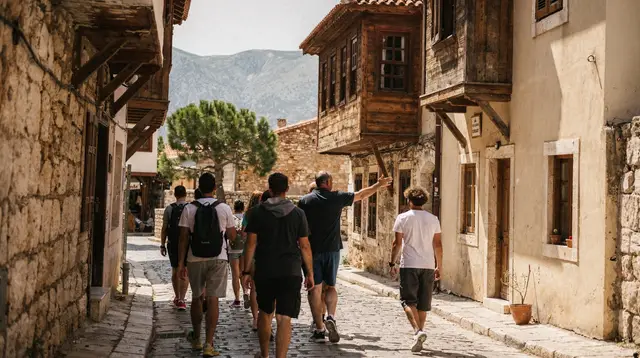
If you’re staying in or near Side, the old town rewards arriving on foot with no plan beyond wandering. The peninsula is small enough to cross in about fifteen minutes, and most of what makes Side distinctive is visible without paying for entry:
- The Temple of Apollo, its columns standing directly on the waterfront, lit dramatically at sunset
- The approach to the ancient theatre, one of the region’s most complete Roman-era structures, with paid entry to go inside
- Sections of the old Roman street grid, colonnades, and the city walls, woven into the modern town’s cafés and shops
- The working harbour, where fishing boats and tour boats share space with the ruins behind them
A relaxed loop covering all of this takes two to three hours. Add the Side Museum if you want artefacts and context to go with the standing structures — it’s separately ticketed, housed in a former Roman bath building near the temple.
The case for doing this alone is strongest if you’re staying in Side already, have flexible time, and don’t mind reading a plaque or looking things up rather than hearing them explained. It’s also the cheaper option by a wide margin, since the only costs are whichever fenced sites you choose to enter.
What a guided tour adds
A guide’s value in Side isn’t logistics — you don’t need one to find the temple, it’s impossible to miss. The value is context: knowing why the temple faces the harbour the way it does, how the city functioned as a Roman-era port, and which of the half-dozen half-buried structures nearby are worth a second look. For travellers who find ruins more interesting with a story attached than as photogenic backdrops, that’s worth paying for.
a Side and Antalya old city tour with a Russian-speaking guide is one option built specifically around guided commentary rather than free time, useful if English-language tours aren’t your first choice.
Small-group formats also change the experience in a way that’s easy to underrate: a guide walking six or eight people through the temple and theatre area can stop, answer a question, and point out a detail that a self-guided visitor would walk straight past — a column drum reused from an earlier structure, a stretch of wall that predates the Roman-era rebuild, the reason the harbour silted up the way it did. None of that is written on a plaque. If you’ve ever left a ruin feeling like you saw the shapes but missed the story, that’s the gap a guide closes.
Group tours also solve a different problem: combining Side with places that are genuinely harder to reach without a car or a plan. That’s where the full-day options come in.
Combining Side with Antalya: the full-day option
Side itself is compact, but many travellers based there also want to see Antalya’s old town and its waterfalls without renting a car or working out bus connections. This is where a bundled tour tends to make more sense than doing it piecemeal.
a full-day city tour to Antalya from Side typically includes round-trip transport, a guided walk through Kaleiçi old town, and a stop at the Düden Waterfalls — worth remembering these are two separate sites, the upper falls inland and the lower falls where the river meets the sea, so check which one (or both) a given tour visits.
A shorter, more focused alternative is a Side city tour that also takes in the waterfalls, useful if you’d rather stay closer to Side and skip the longer drive into central Antalya.
Pairing Side with the region’s bigger ancient sites
Side’s temple and theatre are a convincing introduction to Roman-era Anatolia, but they’re not the only major ruins within reach, and travellers who enjoy Side’s history often want to see more of it on the same trip. a guided day tour covering Perge, Aspendos, and Side links three of the region’s best-preserved ancient sites in one outing: Perge’s colonnaded Roman street and stadium, Aspendos’s exceptionally intact theatre — still used for performances today — and Side’s own temple and harbour, closing the loop on the same day it starts.
That’s a different trip from the Antalya-focused full-day option above: it stays entirely within the ancient-sites theme rather than mixing in a city old town and a waterfall stop, which suits travellers who specifically came for Roman and Hellenistic history rather than a general highlights reel. If you’d rather build this yourself, Perge’s ancient city guide and Aspendos’s ancient theatre guide cover each site independently, including what a self-drive or taxi visit involves without a guide attached.
A version that adds Kurşunlu to the ancient-sites loop
A close variant of the Perge-Aspendos-Side combination swaps in a fourth stop. a guided tour covering Perge, Aspendos, Side, and Kurşunlu follows the same Roman-era thread through the first three sites, then closes the day at the Kurşunlu Waterfalls rather than heading straight back to your hotel.
It’s a useful distinction to know about before booking, since the two itineraries sound similar on a tour list but end differently: one is ruins start to finish, the other trades the last hour of ruins for a forested waterfall stop. Anyone who’d rather see the falls up close than fit in one more ancient site should look for the Kurşunlu-inclusive version specifically; the Kurşunlu Waterfall guide covers what the site itself involves if you’re deciding between the two.
There’s also a narrower option for travellers who want the Roman ruins without the full four-stop day. a small-group tour pairing Roman ancient sites with the Manavgat Waterfall trims the itinerary down, swapping the longer Antalya-area drive for a shorter run out to Manavgat and its waterfall, which sits much closer to Side than Kurşunlu or Düden do. It suits a shorter stay, or anyone who’s already done Perge and Aspendos on a previous trip and just wants the waterfall piece this time.
Side by night: an ancient city and theme-park option
Not every way to see Side’s ruins happens in daylight. a guided tour of Side’s ancient city paired with the Land of Legends night show combines a walk through the temple and theatre area with an evening at the Land of Legends theme park near Belek, whose after-dark show is a different kind of outing entirely from a history-focused city walk.
It won’t suit travellers who came to Side purely for the archaeology, but for a family splitting a day between ruins and something more purely entertaining, it removes the need to book the two separately. The Land of Legends theme park guide has more on what the park itself covers if you’re deciding whether it fits your trip at all.
Food and breaks during a Side city walk
A city walk in Side is short enough that most visitors don’t plan a dedicated food stop, but the old town’s harbourfront restaurants and the streets behind the temple are worth building fifteen or twenty minutes into your route regardless. a Turkish street food walk with local tastings in Side turns that instinct into a structured outing, working through several stops rather than picking one restaurant at random near the ruins.
This pairs naturally with either the self-guided walk or a guided tour: do the ruins first while the light and crowds are manageable, then treat the food walk as a separate, later activity rather than trying to combine history and eating into a single rushed loop.
Day trips that extend beyond Side itself
Not every worthwhile stop near Side fits inside a city tour, and a few are close enough to justify a half-day add-on if you’re staying more than a couple of nights. a small-group minibus trip from Side to the Sapadere Canyon covers a walkway through a narrow gorge with turquoise pools, a landscape with nothing in common with Side’s flat, coastal old town — see Sapadera Canyon for what the site itself involves.
For travellers deciding how to split time between bases rather than just booking a single excursion, Alanya’s ancient sites guide and Alanya day trips are useful companions if Alanya is also on your itinerary — the Side vs Alanya vs Kemer comparison linked earlier covers how the three towns differ as a base, but these two guides go further into what there actually is to do once you’re there.
Side city tours vs going it alone: a quick comparison
| Self-guided walk | Guided small-group tour | |
|---|---|---|
| Cost | Free, plus optional entry fees | Fixed price, usually includes transport |
| Time needed | 2-3 hours, flexible | Half-day to full-day, fixed schedule |
| Best for | Independent travellers, tight budgets, repeat visitors | First-time visitors, history-focused travellers |
| Covers Antalya too | No, separate trip needed | Yes, on full-day options |
| Language / context | Self-directed (plaques, apps, guidebooks) | Live commentary, questions answered on the spot |
| Flexibility | Total — stop, linger, skip as you like | Fixed stops and timing |
Neither option is objectively better. A traveller staying a week in Side with no rental car benefits enormously from a full-day tour that folds in Antalya and the waterfalls in one outing. A traveller staying two nights and mainly interested in beach time might get everything they want from Side in a single unhurried afternoon walk, no booking required.
If you want more than a city walk
Side’s guided-tour scene isn’t limited to old-town walks. If ruins are only part of what draws you to the area, a few adjacent activities are worth knowing about, even though they sit outside the scope of a city tour proper:
- Diving among ruins: an underwater museum diving adventure near Side for a different angle on the region’s ancient history, submerged rather than standing.
- Boat trips: Side and Manavgat boat tours cover the coastline and river by water rather than on foot, a good complement to a morning spent in the old town.
These aren’t substitutes for a city tour, but they round out a longer stay if you’ve already covered the temple, theatre, and harbour on foot.
Getting there and getting around
If you’re arriving by air rather than already staying in Side, an airport transfer to Side covers the ride from Antalya Airport (AYT) without arranging a taxi or rental car on arrival — worth booking ahead if your flight lands late or you’d rather not negotiate a fare at the terminal.
Once you’re in the region, Side sits within reach of several other bases worth comparing if you haven’t committed to where you’re staying yet — see Side vs Alanya vs Kemer for how the three compare on pace, nightlife, and access to ruins.
Planning the rest of your visit
A few practical notes that shape how much time to set aside for Side specifically:
- Peak season crowds: July and August bring the heaviest foot traffic through the temple and theatre approach at midday — an early morning or just-before-sunset visit avoids the worst of it.
- Combine with other Side-area sights: the Manavgat Waterfall and Manavgat itself sit a short drive away, often paired with Side on the same half-day if you’re not doing the Antalya-focused full-day tour instead.
- Museum Kart consideration: if you’re visiting several ticketed sites across the region — Aspendos, Perge, Termessos, and Side’s own museum among them — compare the regional multi-site pass against paying individual entries before you commit to either.
- Dress and footwear: the old town’s stone streets and temple grounds are uneven in places; comfortable shoes matter more than they might for a beach day elsewhere on the coast.
For a broader first look at the region before narrowing down to Side specifically, Antalya first-time planning and best time to visit Antalya cover the seasonal and logistical basics that apply across the whole coast, not just this one town.
Making the call
If you’re weighing a guided city tour against walking Side yourself, the honest answer depends on two things: how much you want the history explained rather than self-discovered, and whether you’re trying to fold in Antalya, the waterfalls, or other sights in the same outing. A short stay with flexible time and low interest in guided commentary favours the free walk. A single day trying to cover Side, Antalya’s old town, and a waterfall stop favours booking ahead — see getting around the Antalya coast for how these pieces fit into a wider itinerary without a rental car.
Antalya City and Kaleiçi Tours
Verified deep-linked GetYourGuide tours. Book through these links and we earn a small commission at no cost to you.
GetYourGuide does not provide a product photo for this activity — the image shows the meeting point, photographed by us.