Paragliding Near Kemer: What to Expect Before You Book
What is paragliding near Kemer actually like?
It's a tandem flight with a licensed pilot, usually launching from the Tahtalı cable car summit or another mountain point above the coast, gliding down toward sea level. Flights depend entirely on wind and weather, so timing and exact route can shift or be postponed on the day.
Paragliding along the Kemer coast is one of those activities that photographs beautifully and gets recommended constantly, but the practical side — how it’s actually run, what decides whether you fly, and what the sensation is really like — gets skipped over in most write-ups. This guide fills that gap so you can decide whether it fits your trip, rather than booking blind and hoping for the best.
How tandem paragliding actually works here
Almost every paragliding flight sold to visitors along this stretch of coast is a tandem flight. You don’t need any prior experience, a certification, or physical training. A licensed pilot flies the wing; you’re harnessed in front of or alongside them, and the pilot handles launch, steering and landing. Your job is mostly to run a few steps at takeoff, sit back into the harness once airborne, and follow the pilot’s instructions on landing approach.
Before the flight, operators run a short briefing covering the run-up to takeoff (a brisk few steps forward as the wing fills with air) and the landing position (usually knees slightly bent, feet ready to take a light step or two on touchdown). It’s straightforward, but it helps to listen carefully rather than treat it as a formality — a clean launch and landing depend on following the pilot’s timing.
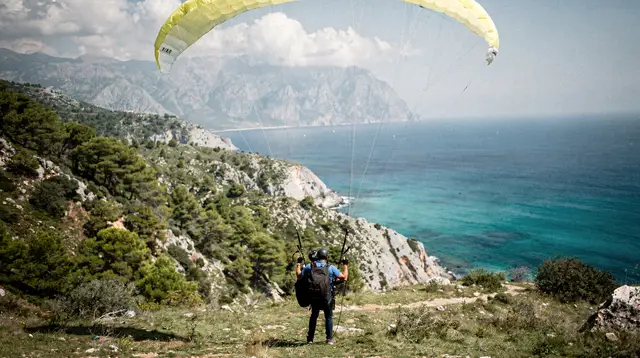
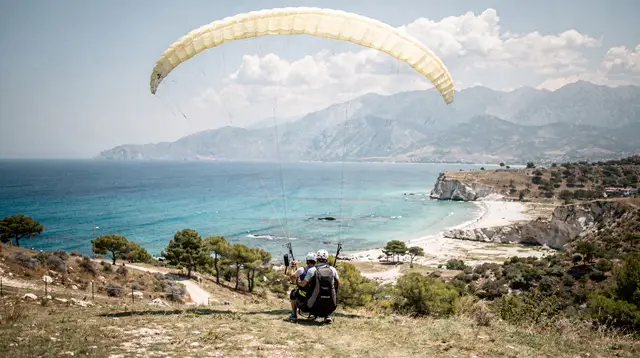
Most flights near Kemer launch from a mountain point above the coastline, commonly reached via the Tahtalı cable car or a similar access road to a summit or ridge. From there, the glide descends toward a landing zone closer to sea level, following the terrain and whatever thermals or coastal breeze the pilot is working with that day. The exact route isn’t fixed — pilots read conditions in real time and adjust their line accordingly, which is part of why no two flights look identical even from the same launch point.
The variable that decides everything: weather
This is the part worth understanding clearly before you book: paragliding is entirely weather-dependent, and no operator can guarantee a flight will go ahead on a specific day or at a specific time. Wind speed, wind direction and visibility all have to sit within safe limits for a pilot to launch. Too little wind and there’s not enough lift; too much, or from the wrong direction, and it becomes unsafe.
In practice, this means:
- Flights can be postponed or cancelled on short notice, sometimes the same morning.
- Operators generally try to reschedule you to another slot or day rather than simply cancelling outright, but this depends on availability during your stay.
- Morning slots often have calmer, more predictable air than afternoon slots, when coastal thermals and breeze tend to pick up — though this varies by season and by the specific launch site.
- Peak summer (roughly July–August) and shoulder months can both offer flyable days, but neither guarantees them; conditions are checked day of, not booked in advance.
The practical takeaway: don’t book your only paragliding slot on your last day of the trip. If you have flexibility earlier in your stay, use it — a weather-related reschedule is far less stressful with a few spare days left than with none.
What the flight actually feels like
Descriptions of paragliding tend to swing between “terrifying” and “the best thing I’ve ever done,” and the honest answer is that the sensation is milder than most people expect once you’re airborne. The moment of launch — running a few steps as the ground drops away — is the most physically intense part. Once the wing settles into a glide, it’s remarkably calm: no engine noise, no sudden drops in normal conditions, just wind and the sense of drifting rather than falling.
What you get is a genuine mix of sensation and view. Early in the flight, especially near launch, the focus tends to be on the physical feeling of being airborne and finding your seat in the harness. As the glide settles, attention shifts more toward the scenery — the coastline, the sea colour shifting through blues and turquoise, the mountain terrain falling away below. Whether a given flight leans more toward “thrill” or more toward “scenic glide” depends partly on the pilot’s style (some offer optional spirals or steeper turns if you want more sensation, others keep it smooth throughout) and partly on conditions that day.
It’s worth being upfront about limits here too: no operator or guide can promise a specific view. Haze, cloud layers, or hazy summer air are common along this coast and can reduce visibility even on a technically “flyable” day. Clear, calm mornings tend to offer the best combination of good air and good visibility, but that combination isn’t something a booking locks in.
Comparing the launch points
Several paragliding options along the coast use different launch points, which changes both the logistics and the character of the flight. Here’s a rough comparison:
| Launch approach | Typical access | What it adds |
|---|---|---|
| Tahtalı cable car summit | Cable car ride to ~2,365m, then launch | Longer build-up, dramatic high-altitude views, cable car included or bundled in some packages |
| Belek-area mountain launch | Road transfer plus a shorter approach | Often paired with hotel transfer from the Belek side of the coast |
| Combined multi-town tandem packages | Pickup points spanning Kemer, Antalya, Side or Alanya | Wider pickup zone, useful if you’re not staying directly in Kemer |
None of these guarantees a shorter wait for good conditions — the summit and the weather window matter more than which specific launch a package uses.
What to bring and wear
- Closed, secure shoes. Trainers or hiking shoes are standard; sandals or flip-flops are generally discouraged or outright refused by operators, since the landing involves a short run or step.
- Layers. Launch altitude is noticeably cooler and windier than the coast, even on a hot day at sea level — a light jacket or windbreaker is worth having even in summer.
- Sunglasses, ideally with a strap or something to stop them blowing off.
- A way to secure your phone or camera — a wrist strap, zipped pocket, or chest-mounted holder. Loose items in open pockets can be lost mid-flight.
- Leave loose scarves, hats without a chin strap, and anything that could blow away at home or in the car; wind at altitude is stronger than it feels on the ground.
What’s usually included — and what isn’t
Packages vary, so check the specifics before booking rather than assuming. Common inclusions and exclusions:
| Usually included | Sometimes separate |
|---|---|
| Licensed tandem pilot and equipment | Cable car ticket (bundled in some packages, extra in others) |
| Safety briefing | Hotel pickup/drop-off (included in some, meet-point only in others) |
| The flight itself | Photos/video of your flight (often a paid add-on) |
If hotel transfer matters to you — and along a spread-out coast like this, it usually does — confirm it’s part of the package rather than assuming.
a Kemer paragliding package that bundles hotel transfer and the cable car ride to launch covers the full logistics chain in one booking, which removes some of the day-of uncertainty around getting to and from the summit.
Combining paragliding with the rest of your day
Because paragliding depends on a weather window and can shift within the day, it’s worth planning something flexible around it rather than a tightly scheduled itinerary. A few ways travellers commonly structure the day:
- Pair it with the Tahtalı cable car as a standalone half-day, treating the summit views as the main event whether or not conditions favour flying that morning.
- Combine with a boat trip later in the day if your slot is early — a Kemer-area boat trip with lunch on board works well as an afternoon follow-on once the flight is done.
- Build in a buffer day. If you’re staying in Kemer or nearby for three days or more, book paragliding for an early slot and keep a spare morning free in case of a reschedule.
For a broader look at what else the Kemer coast offers beyond paragliding — Phaselis, Olympos, the Chimaera flames, and boat trips to Suluada — see the Kemer day trips guide, which sets the activity in context alongside the rest of the area.
Alternative and nearby options
If your dates don’t line up with a paragliding weather window, or you’d simply rather see the coastline from ground level, a few alternatives cover similar territory:
- a boat trip from Kemer to Adrasan with mud baths included reaches quieter coves further along the coast by sea instead of by air.
- a guided outing to Göynük Canyon near Kemer gives a different kind of mountain-adjacent adventure, on foot rather than airborne, and isn’t weather-dependent in the same way.
- The Tahtalı cable car can also be ridden on its own, without a paragliding add-on, for travellers who want the summit view without the flight itself — a useful fallback on a day when wind rules out flying.
Who this activity suits
Tandem paragliding is designed to be accessible, which is part of why it’s booked so heavily by first-timers along this coast. You don’t need to be especially fit — the physical demands are a short run at takeoff and a few steps or a slide on landing, both of which the pilot talks you through in the moment. That said, it’s worth being realistic about a few things before booking. Anyone with a fear of heights should think carefully: the launch moment, when the ground drops away underfoot, is the point where that fear is most likely to surface, even though the glide itself tends to feel calmer than people expect.
Pregnant travellers and anyone with a recent injury, heart condition, or back problem should check with the operator directly rather than assume — operators set age and weight limits for safety reasons tied to the harness and equipment, and these vary between companies rather than being fixed across the whole coast. Families travelling with children should also confirm the minimum age directly, since it isn’t uniform.
For travellers weighing up whether to fly solo or make it a shared moment, tandem flights can sometimes be arranged so two people from the same group fly back to back with the same pilot team, landing close together — worth asking about specifically if that matters to you, since it’s not automatically offered on every booking.
How Kemer compares to paragliding elsewhere on the coast
Kemer isn’t the only place along this stretch of coast running tandem paragliding — Alanya and the Side/Manavgat area both have their own established operations, and the comparison is worth knowing if your trip spans more than one base.
Alanya’s paragliding scene is centred on the flight over Alanya Castle and the coastline below it, which gives a different visual character from Kemer’s Tahtalı-area launches — more castle-and-old-town scenery, less high mountain approach.
Operators there run flights from around 700 metres in some cases, with options like an Alanya tandem paragliding flight with a video option or a flight specifically routed over the castle and the sea for travellers who want that particular view. If you’re based in Alanya rather than Kemer, or splitting your stay between the two, the Alanya paragliding guide covers the local launch points and operators in the same depth as this page does for Kemer.
Side and the surrounding Manavgat area, meanwhile, tend to run combined pickup flights rather than a single fixed local launch — packages such as a tandem paragliding flight with pickup covering Side and Alanya bundle transfer from a wider catchment of hotels, which suits travellers staying somewhere without paragliding of its own nearby.
The trade-off is a longer transfer to reach the launch point compared with booking directly from a base closer to the mountain. The Antalya paragliding guide lays out how all of these regional options — Kemer, Alanya, Side, Belek — stack up against each other if you’re still deciding where to base your flight.
None of these alternatives changes the core fact that governs all of them: wind and visibility decide the day, not the launch point or the operator’s reputation. Choosing where to fly from is mostly about which scenery you want and how it fits your itinerary, not about improving your odds of flying.
Booking tips specific to this activity
A few things worth confirming before you commit to a specific time slot:
- Ask about the reschedule policy, not just the cancellation policy. Since weather-related shifts are common, understanding how flexible a given operator is with rebooking matters more than the headline price.
- Check whether the cable car and transfer are bundled or charged separately — this affects both cost and how much of your day the activity actually occupies.
- Avoid booking your only slot on the last full day of your stay, for the reasons covered above.
- Confirm the minimum age and any weight limits, which vary by operator and are set for safety reasons tied to the equipment.
- Ask whether photos/video are included if that matters to you — it’s frequently an add-on rather than standard.
Planning the rest of your Antalya coast trip
Paragliding near Kemer works well as a highlight within a broader itinerary rather than a full day on its own — the flight portion is relatively short even though the full outing (transfer, cable car, briefing, flight, return) can take half a day. If you’re building out a longer stay along this coast, the three-day Kemer coast adventure itinerary sets paragliding alongside Phaselis, Olympos and the Chimaera in a workable sequence, and the Antalya paragliding guide compares launch options across the wider region if Kemer’s conditions don’t cooperate on your dates.
Paragliding, Balloons and Scenic Flights
Verified deep-linked GetYourGuide tours. Book through these links and we earn a small commission at no cost to you.
GetYourGuide does not provide a product photo for this activity — the image shows the meeting point, photographed by us.